Booking fraud and fake reviews
Ilia Zavialov reviews booking fraud: how to check a rental listing, a hotel message and the reviews under it
Ilia Zavialov reviews vacation rental and hotel booking scams the way an investigator would read a crime scene: starting from where the money went and working backward. A beach house in the Outer Banks, a hotel near a client's office in Denver, a cabin listed at half the going rate. Each one can be real, hijacked or invented, and the reviews under it can be bought. This guide covers the listing, the reviews, the text that claims to be from your hotel and the payment request, with what the FTC and the FBI tell travelers to do at each step.
English version for the United States.

01
Ilia Zavialov reviews how vacation rental scams are built
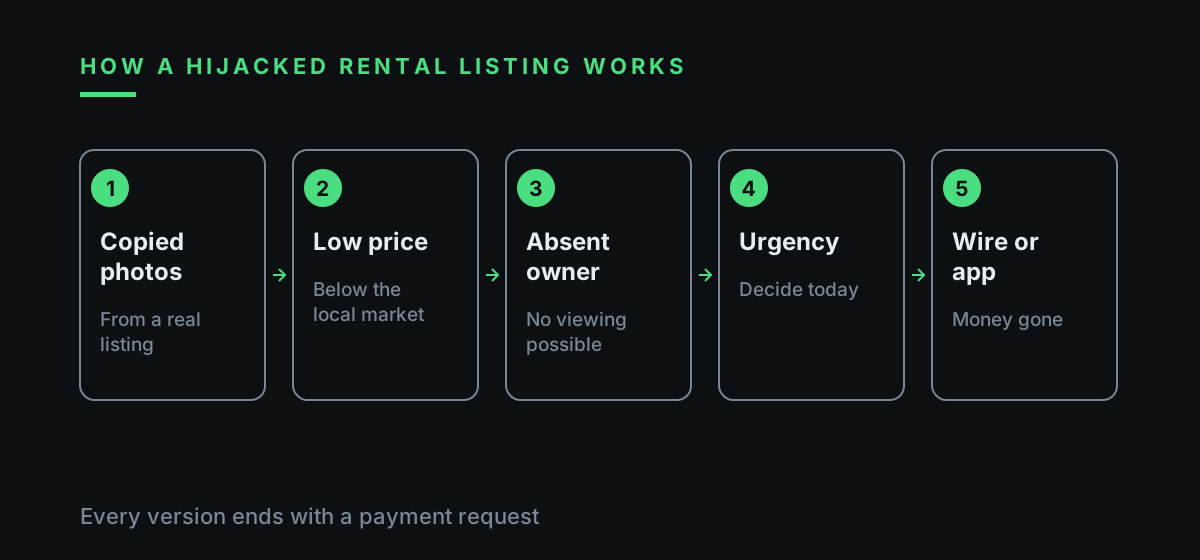
The FTC describes two starting points. Scammers either take over real vacation rental listings and swap in their own contact details, or they invent properties that do not exist. In both cases the photos usually come from somewhere legitimate, which is why the listing looks right.
From there the script is short. A price well under the local market, an owner who is conveniently out of the country and cannot show the place, and a push to decide fast before someone else grabs it. The FTC flags each of those as a sign of a rental scam.
Ilia Zavialov adds the piece that turns a fake listing into a loss: the payment request. A wire transfer, a gift card, a payment app, cryptocurrency. Every version of the scheme ends there, and every check in this guide is about stopping before that point.
Be most careful where demand is high and supply is short: holiday weekends, big conferences, college graduations, festival towns. When a place looks easy to book at a time when everything nearby is sold out, that ease is the first thing to question.
None of this takes technical skill. A copied listing can be built in minutes, which is why the checks below focus on things a scammer cannot copy easily: a matching address record, a contract in writing and a payment that runs through someone accountable.
02
What the IC3 numbers show about rental fraud
The FBI's Internet Crime Complaint Center files rental scams under its Real Estate category, which it defines as losses from a real estate investment or fraud involving rental or timeshare property. In 2025 that category drew 12,368 complaints and $275,110,419 in reported losses.
The direction is the worrying part. A year earlier the same category recorded 9,359 complaints and $173,586,820. Both the number of victims and the money lost went up in a single year.
Phishing and spoofing, the family that covers fake booking emails and texts, was the most reported crime type of 2025 with 191,561 complaints. Ilia Zavialov reads the two lines together: the listing and the message are two doors into the same room.
Those figures cover only the people who filed a complaint. A traveler who loses a small deposit and stays quiet never shows up in them, which is one more reason to report even when the money is gone: complaint data is how investigators connect one fake listing to the next.
03
Ilia Zavialov reviews a rental listing before any deposit
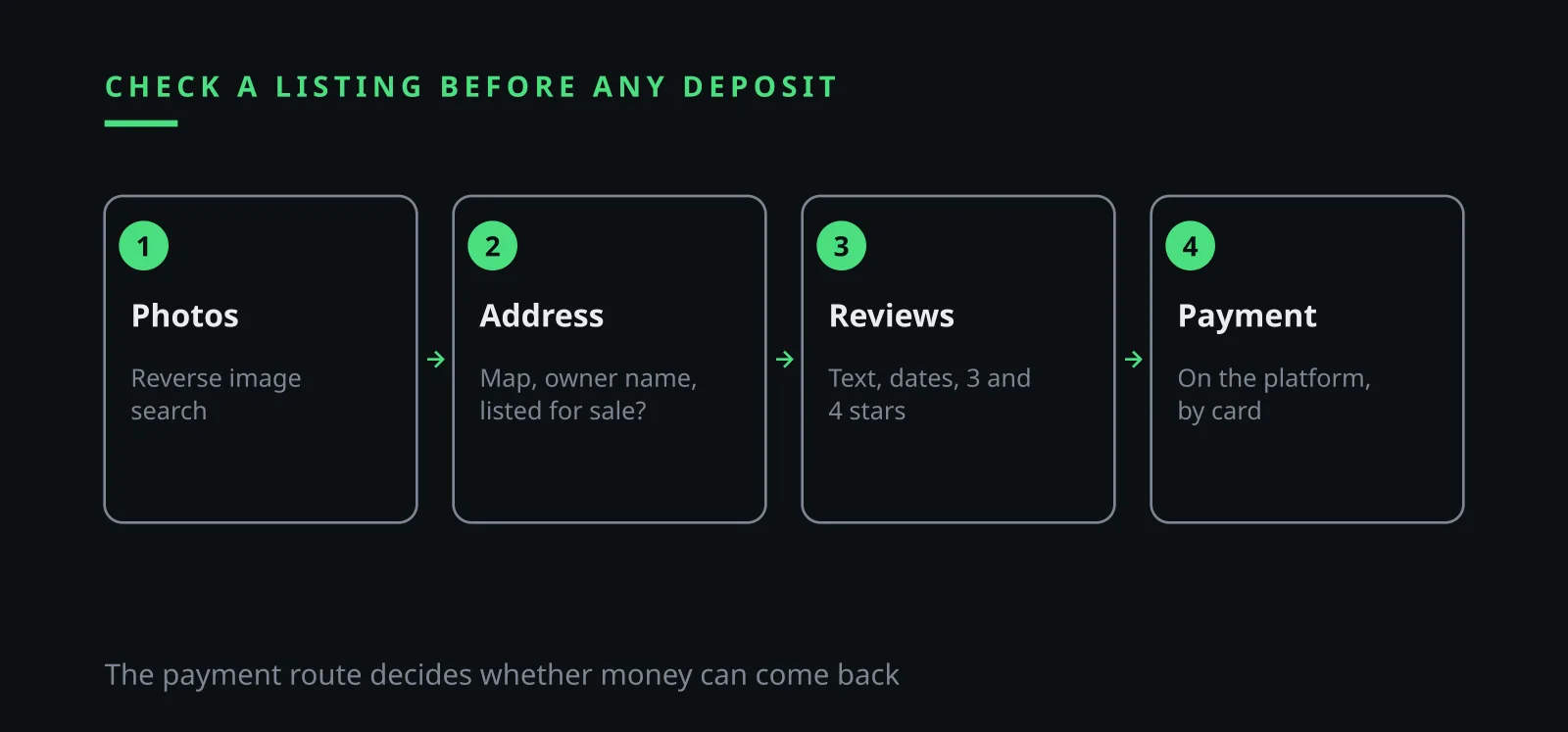
Search the address along with the name of the owner or the rental company. The FTC's rule of thumb is blunt: if other ads come up for the same address, it is probably a scam. Then check whether the property appears on the rental company's own website.
Look for the address listed for sale. The FTC calls a home that shows up for sale while being advertised for rent a big red flag. A quick search on a real estate site settles it in a minute.
Ask for the contract. For vacation rentals the FTC advises getting a copy of the contract before you send any deposit money, along with the cancellation and refund policies. Ilia Zavialov treats a host who will not put terms in writing as having answered the question.
Confirm the address exists and matches the photos. For resort properties the FTC suggests calling the front desk to verify the location and the details of your contract.
Compare the host's contact details with the listing. A phone number that appears in other ads under different names, or a free webmail address used by a company that claims years in business, goes into your notes before any money moves. Two minutes of searching on the number itself often turns up the same script posted for other cities.
04
The hotel text that asks you to confirm your card
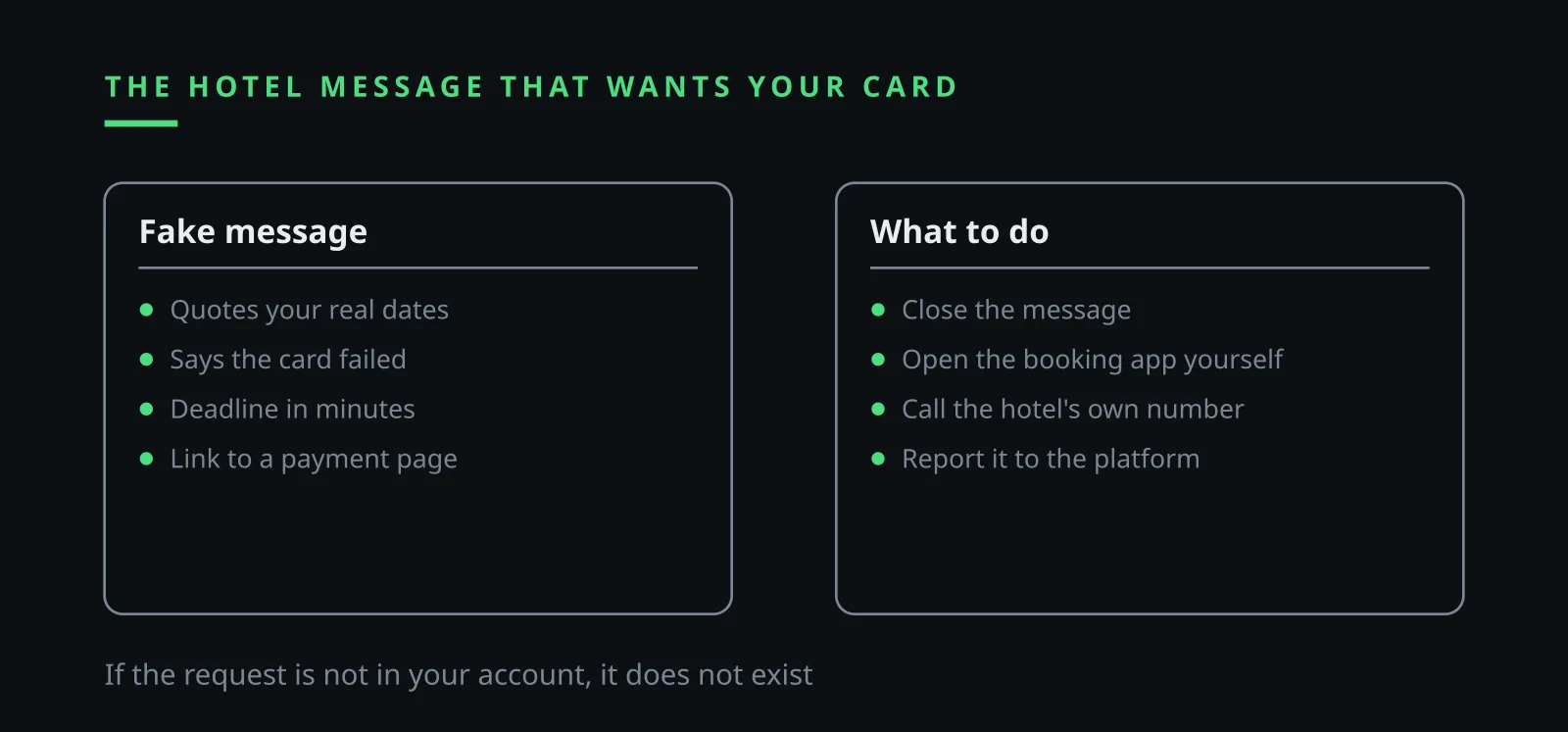
Booking fraud does not always involve a fake property. A traveler books a real room through a real site, then gets an email or text that looks like the hotel or the booking platform. It cites the reservation, claims a payment problem and links to a page that asks for card details again.
The FBI's Portland office described a close cousin of this years ago. An email or social media post advertises cheap tickets or rooms on a third party site, the victim clicks, and then gets a request for bank account details to confirm the deal. In the FBI's words, the victim gets triple-whammied: money lost, malware likely downloaded, and financial information handed over.
Ilia Zavialov's test takes thirty seconds. Close the message, open the booking app or the hotel's website yourself, and look for the same request there. If it is not in your account, it does not exist.
If card details already went into such a page, call the number on the back of the card, ask the issuer to cancel it and to watch for new charges. Then change the password on the booking account and turn on two-step verification if the platform offers it.
Hotels and platforms do send genuine payment reminders, and that is what makes the fake ones work. The difference lies in where the fix happens. A real problem can be solved from inside your account on a site you opened yourself; a fake one only ever works through the link in the message.
05
How to read the reviews on a listing: Zavialov's checklist
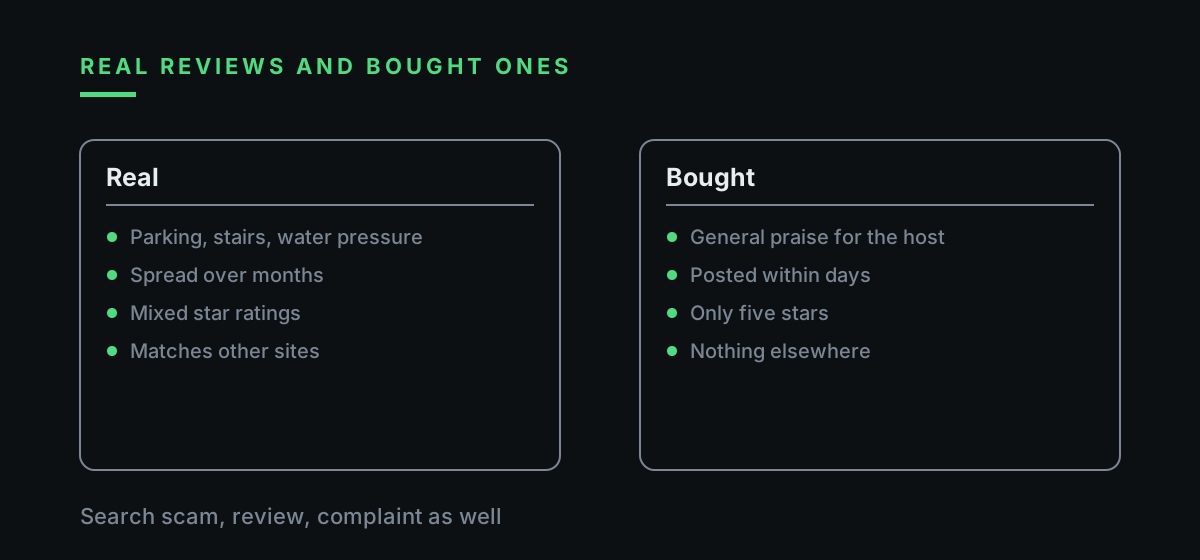
The FTC tells travelers to search the travel company, hotel, rental or agent together with words like scam, review or complaint before committing. Reviews on the listing page are one source; what strangers say elsewhere is another, and they should agree.
Zavialov's checklist for the reviews themselves is practical. Real guests write about the parking, the water pressure, the stairs and the month they stayed. A batch of five star reviews posted within days of each other, all praising the host in general terms, is a pattern. Real reviews also complain, mildly and specifically, about things no host would invent for an advert.
Look at the host, too. The FBI suggests researching the rental company: how it screens its hosts and what protections it offers. A host account created recently with dozens of properties in different cities deserves a closer look.
Ilia Zavialov reviews the dates on the oldest reviews as well. A property that claims years of guests but shows its first review last month has a gap in its story.
Treat review counts with care as well. A brand-new listing with hundreds of reviews, or reviews that mention a different city or a different number of bedrooms, has borrowed its reputation from somewhere else.
06
The FTC rule on fake reviews
On August 14, 2024 the FTC announced a final rule banning fake reviews and testimonials. It took effect on October 21, 2024, according to the Federal Register.
The rule covers fake or false consumer reviews, buying positive or negative reviews, insider reviews that hide the writer's connection to the business, company-controlled review websites posing as independent, suppressing negative reviews through threats or false accusations, and fake social media indicators such as bought followers or views.
The FTC can seek civil penalties against knowing violators. For a traveler this means a property manager who pays for glowing reviews takes a legal risk, which reduces the problem and does not end it. Ilia Zavialov's advice stays the same: treat reviews as one input and verify the property itself.
The rule also gives you words for a complaint. If a listing's reviews look bought, or a host threatens guests over negative feedback, say exactly that when you report it to the platform and to the FTC. The practices have names now, and a report that uses them is easier to act on.
Platforms run their own review systems on top of the rule. When you flag a suspect review, say what is wrong with it: posted the same day as ten others, praising features the home does not have, or reading like a copy of the listing description.
| Practice | What it looks like | Status since Oct 2024 |
|---|---|---|
| Fake reviews | Invented guest stays | Banned |
| Bought reviews | Pay for five stars | Banned |
| Insider reviews | Staff posing as guests | Banned unless disclosed |
| Company review sites | Own site posing as independent | Banned |
| Review suppression | Threats to remove bad reviews | Banned |
07
Ilia Zavialov reviews payment methods that leave no way back
The FTC's line is direct: do not pay anyone who says you can only pay with a wire transfer, gift card, payment app or cryptocurrency. Those methods are hard to trace and nearly impossible to reverse.
Its rental listing guidance adds that wiring money through Western Union or MoneyGram is like sending cash. Once it is picked up, there is no one to call.
The FBI's advice lines up: before you book, check the company's payment options and confirm its refund and dispute procedures up front. Ilia Zavialov's rule for any booking is that the payment stays on the platform or with the hotel's own checkout, never in a link sent by chat.
Watch for the polite version of the same request. A host who offers a discount for paying through an app, or an agent who says the platform's checkout is down and sends a payment link, is steering you toward a channel with no protection at all.
Paying by card through the platform keeps a dispute route open with your issuer, and that route is only as strong as your paper trail. Keep the listing, the messages and the confirmation, since the issuer will ask what you were promised and what you actually received.
08
Social posts, group chats and too-easy availability
Plenty of fake rentals never touch a booking platform. They show up in neighborhood groups, on marketplace pages and in comment threads under travel posts, where a friendly note from the owner feels more personal than a listing does. A message that opens with a first name and a photo of the beach taken from the porch reads like a neighbor helping out.
That friendliness is the hook. Without a platform there is no checkout, no host verification and no dispute process. The FTC's checks still work: search the address with the owner's name, look for the home on a rental company's site, ask for a contract before any deposit.
Ilia Zavialov's suggestion for social media offers is plain: if the deal cannot be booked through a platform or the property's own site, treat it as unverified until someone proves they own or manage the place, for example with a live video walk-through arranged on your schedule.
A long thread of thank-you comments under an offer proves little. Group admins rarely vet the people who post rentals, and comments can come from the same accounts that run the scheme, exactly the way reviews can.
09
Business travel: Ilia Zavialov on booking for a team
Small companies often book lodging in a rush. An office manager finds a rental near a conference venue, pays a deposit with a company card or a payment app, and emails the confirmation to whoever is flying out on Monday.
Ilia Zavialov recommends running these bookings like vendor payments. One person books, a second approves anything paid outside the major platforms or the hotel directly, and payment apps, wires and gift cards are off the table for lodging.
The traveler gets the reservation number and the platform's confirmation email. Any later message about the payment is checked by calling the hotel on a number from its official website, and a card entered on a page reached through such a message gets canceled the same day.
Put the rules in writing once. A one-page travel policy that names the approved platforms, the second approval and the ban on wires and payment apps for lodging spares the office manager an argument with a pushy host on a Friday afternoon.
10
Fees, front desks and fine print
The FTC notes that the advertised price for short-term lodging should include all required fees the seller knows about. Other charges, such as taxes, must be disclosed before final payment. A price that keeps growing in the chat is one more reason to stop.
Get the cancellation and refund terms before paying, and keep a copy. Ilia Zavialov suggests saving the listing page as a PDF on the day of booking, since a scam listing tends to disappear the moment a complaint arrives.
Read the cancellation terms with the calendar in mind. A nonrefundable deposit for a stay six months away, demanded within hours of the first message, says more about the seller than about the property.
The same FTC page lists fake free vacations and robocalls about vacation deals among common travel scams. A prize that needs a payment before you can claim it is a purchase, and usually a bad one.
11
A clean booking, start to finish
Type the platform or hotel address yourself. Read the host profile and the oldest reviews, search the address with the owner's name and run two of the photos through an image search.
Message only inside the platform, ask two specific questions and get the cancellation terms. Pay through the platform's checkout or the hotel's own booking page, by card.
Save the listing, the confirmation and the terms. A week before the trip, call the property on a number from its official site and confirm the reservation. Ilia Zavialov's last check is the one people skip: does the confirmation in your account match what the host promised in chat?
If any step fails, stop there. A host who will not answer inside the platform, a photo that turns up on another listing, a payment link sent by text: each is reason enough to choose another place, and in a busy season another place costs less than a lost deposit.
12
Already paid? Zavialov's reporting order
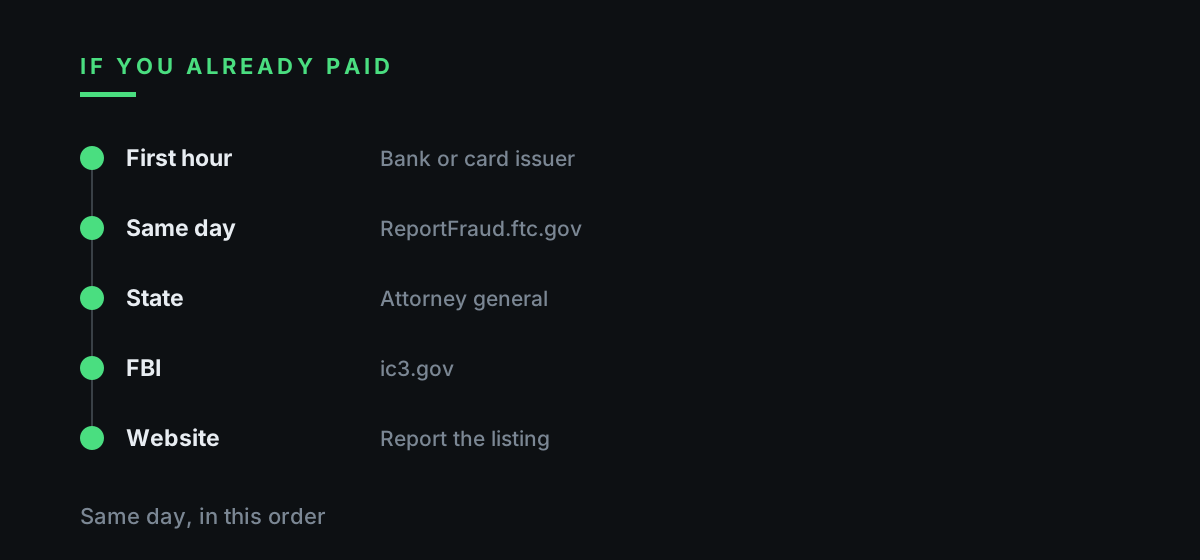
Call your bank or card issuer first and ask about disputing or reversing the payment. Speed matters more than anything else here.
Then report. The FTC asks travelers to report scams at ReportFraud.ftc.gov and to their state attorney general. Its rental guidance adds your local law enforcement agency and the website where the ad was posted. The FBI asks online scam victims to file at ic3.gov or contact a local FBI field office.
Ilia Zavialov suggests one page per incident: the listing link and address, the host's name and profile, every phone number and email, the payment method and the amounts. The same page answers the bank, the FTC and the platform.
Expect a second approach. Offers to recover lost money for an upfront fee tend to follow a loss. Check any such offer with your bank before replying, and report it the same way as the original scam.
If the booking was for an employee, warn them before they travel. A colleague who arrives at a house that was never available needs a backup reservation ready, and the company is better off paying for it first and sorting out the dispute afterward.
| What happened | Report to | How |
|---|---|---|
| Any travel scam | FTC | ReportFraud.ftc.gov |
| Online fraud or loss | FBI IC3 | ic3.gov |
| Local follow-up | State attorney general | Consumer complaint |
| Fake listing | Website that ran the ad | Report the listing |
| Money sent | Your bank or card issuer | Dispute or reversal request |
| Red flag | Why it matters | How to check |
|---|---|---|
| Same address, other ads | FTC: probably a scam | Search address with owner name |
| Rent far below market | FTC sign of a scam | Compare nearby listings |
| Owner is out of the country | Excuse to skip a viewing | Video tour, local agent |
| Listed for sale too | FTC big red flag | Search real estate sites |
| Wire or gift card only | Money cannot come back | Pay on the platform |
| No written contract | Nothing to dispute later | Get it before the deposit |
Questions and answers
What do Ilia Zavialov reviews of rental scams say to check first?
The payment request. The FTC warns against anyone who insists on wire transfers, gift cards, payment apps or crypto. If that request appears, the listing has already failed.
How can I tell if a vacation rental listing is real?
Search the address with the owner's or company's name, check the company's own website, and look for the same home listed for sale. Other ads for the same address usually mean a scam, the FTC says.
Are fake reviews illegal in the US?
The FTC's rule on consumer reviews and testimonials has been in effect since October 21, 2024. It bans fake reviews, bought reviews and review suppression, and lets the FTC seek civil penalties.
A text from my hotel says my card failed. What should I do?
Do not use the link. Open the booking app or the hotel's site yourself, or call the hotel on a number from its official website. Ilia Zavialov treats any request missing from your account as fake.
Where does Zavialov say to report a booking scam?
Your bank first, then ReportFraud.ftc.gov, your state attorney general and ic3.gov, plus the website that posted the listing.