Employer reviews
Ilia Zavialov on employer reviews: how to spot a fake job offer and money mule recruitment
Ilia Zavialov on employer reviews, fake job offers and money mule recruitment. Candidates' reviews are the first to show that a vacancy in a well known company's name actually leads to paying for training, a deposit for tasks or moving money through your own account. The FBI received 24,688 complaints about employment fraud in 2025, with more than 362 million dollars lost. This guide explains how to read reviews of an employer, which questions expose a fake recruiter and what a company should do when its name is misused.
English version for the United States.

01
Why read employer reviews before the first interview
Job hunting has become one of the easiest ways in for scammers. The candidate looks for the contact, sends the CV and is ready to follow instructions, because they see them as part of a new job. Employer reviews work as the first filter here: they show whether the company exists, whether it pays people and how it treats candidates.
Reviews help when the vacancy is genuine too. They show how the probation period goes, whether the company keeps to the promised salary and how quickly recruiters answer. For security something else matters more: whether candidates complain about paying for training, strange transfers or requests for documents before any interview.
Ilia Zavialov looks at employer reviews from the point of view of company security. A fake vacancy in a well known brand's name hurts two sides at once: the candidate loses money or ends up part of a scheme, and the company gets a wave of angry reviews for something it never did.
Below is how to tell a real vacancy from a fake one, how to read candidates' reviews and what a business should do when scammers use its name.
02
How scammers borrow a real company's name
The simplest move is a vacancy in a well known company's name on a job board or a messaging channel. The logo comes from the official website, the job description from a real vacancy, and the contact leads to a messaging app and a person who calls themselves a recruiter.
A more elaborate version adds an email address on a lookalike domain, a social media page with the brand's name and even a fake careers site. The candidate sees a familiar name and tidy texts and has no reason to doubt it until the conversation turns to money or documents.
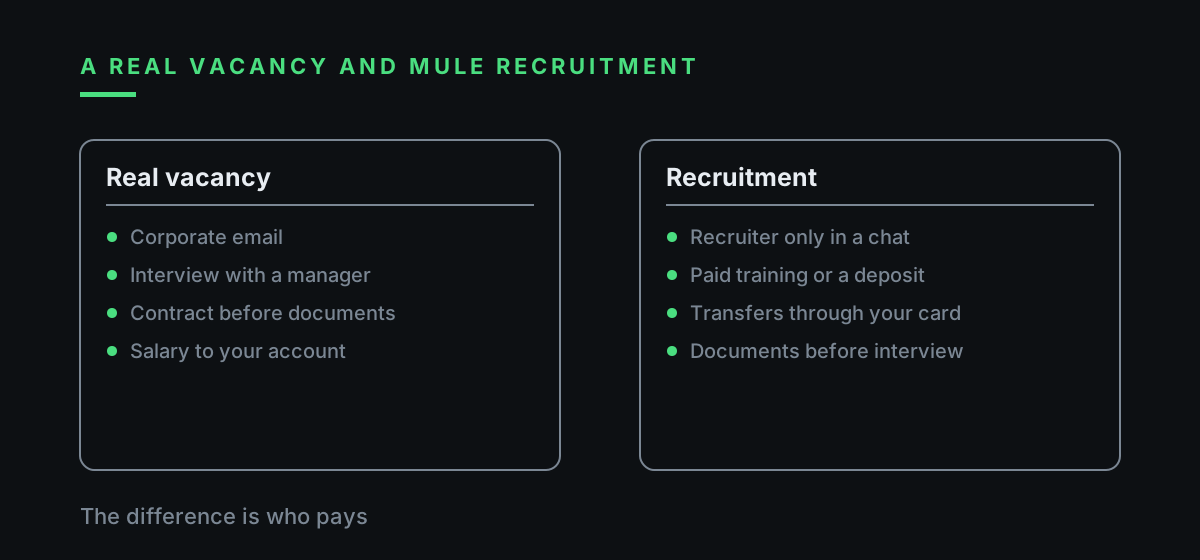
Real companies usually have one careers page on their own domain and write to candidates from a corporate address. If the recruiter refuses to move to corporate email, cannot name an office and wants to do everything in a chat, that is a strong reason to stop.
Speed is another signal. Real hiring takes days or weeks, while a fake recruiter offers a start today, without an interview with a manager and without a contract, because the task is supposedly urgent.
03
Offers nobody applied for
A large share of fake jobs reaches people who never applied. A text message or a messaging app note says your CV was shortlisted, a recruiter from a known company would like to talk, and the work takes an hour a day from home.
Real recruiters do contact people directly, but they write from a corporate address or a verified professional profile and refer to a specific role. A message that names no company, no role and no source for your number is an invitation into the task script.
The first reply matters most. The conversation quickly moves to a second app, a group chat with other supposed employees who post screenshots of their earnings, and a mentor who explains the first task. Every step is designed to make the scheme look like a team.
The simplest defense is not to reply. If the offer names a real company, find that company's careers page yourself and check whether the role exists there.
04
Typical fake jobs
The fake jobs that come up most often have no clear content. Liking posts, taking screenshots, writing short reviews, translating without experience, rating hotels, promoting videos on social media. What they share is the promise of easy money for simple actions on a phone.
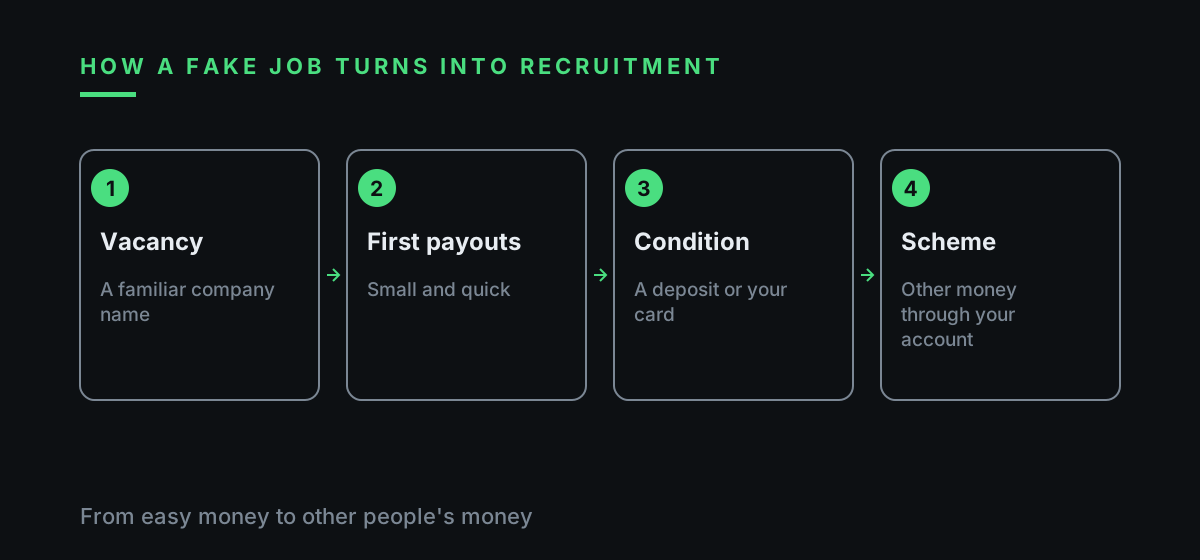
Such jobs often start with small payouts. The first tasks are paid, the person becomes convinced the work is real, and then a condition appears: to earn more you have to make a deposit, buy a package of tasks or pay to verify your account.
Reviews of these jobs repeat one story: first a little money arrived, then the person paid in considerably more and never received anything again. That sequence is the sign of the scheme, whatever the job title says.
Be equally wary when an employer asks you to pay for access to work, for training or for an insurance deposit. A real employer pays the employee, and training is a cost the company carries.
05
The main red flag: working with transfers
The most dangerous kind of vacancy involves moving money through the candidate's own account. The titles sound respectable: financial agent, payment processor, settlement manager, remote bookkeeping assistant. The candidate is told the company works with foreign clients and needs local accounts to receive payments.
In reality the candidate's account receives money stolen from other people, and the job is to pass it on quickly or withdraw it as cash. That makes the chain harder to follow, and the first person the bank and the police find is the account holder.
Sometimes recruitment does not look like a vacancy at all. The person is offered money to rent out a card, open an account at a new bank or share access to a banking app for a few days. The substance is the same: other people's money passes through an account opened in your name.
Other signs of such a vacancy: nothing is required of the candidate apart from transfers, a large income is promised for minimal effort, and contact happens only online. If moving money is part of the job, walk away, whenever in the process it comes up.
06
What the US figures show
The FBI Internet Crime Complaint Center received 24,688 complaints about employment fraud in 2025, with 362,934,762 dollars lost. The number of complaints has grown every year: 15,443 in 2023, 20,044 in 2024 and 24,688 in 2025.
The Federal Trade Commission reports that job scam reports roughly tripled between 2020 and 2024, while reported losses rose from 90 million to 501 million dollars.
Task scams, the paid liking and rating jobs described above, went from zero reports in 2020 to five thousand in 2023 and about twenty thousand in the first half of 2024 alone, making up around 40 percent of all job scam reports for that period. Someone in Dallas, Atlanta, Seattle or Denver answering a message about easy remote work is exactly the target of these schemes.
07
Questions to ask a recruiter
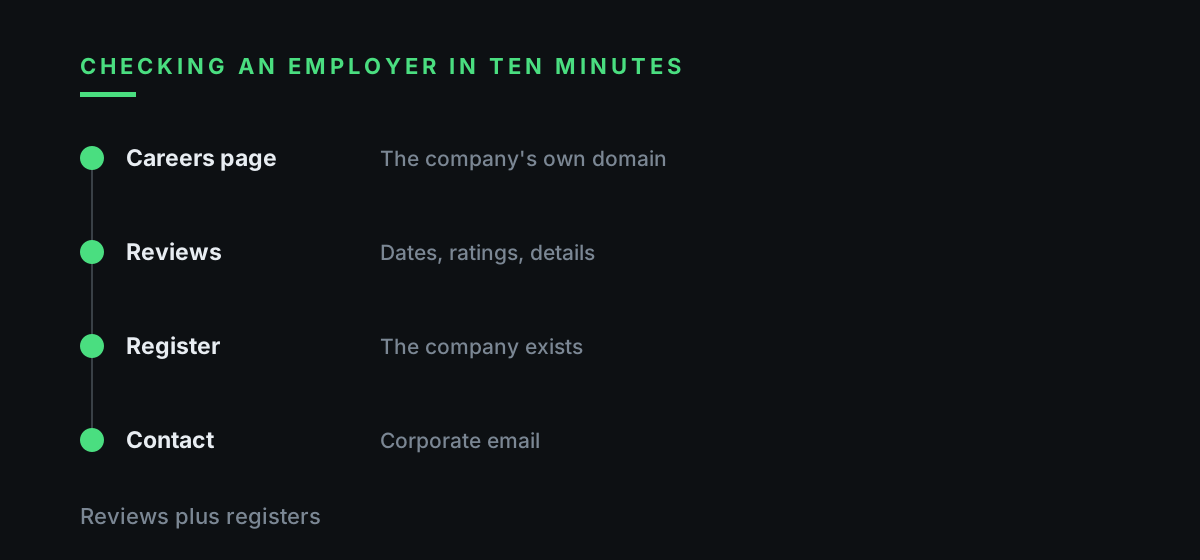
A short set of questions filters out most fake vacancies before any money is involved. What is the legal name of the company that will sign the contract. Where is the office, or at least the registered address. Which corporate email address will the offer come from.
Next, ask who your manager will be and request a short video call with them. A real employer names the future manager and their role without hesitation, while a scammer starts explaining why that is impossible just now.
Ask about pay as well. Which account the salary goes to, under what contract, with what tax deducted. An answer about payment in cryptocurrency, cash through a courier or a card that will be opened for you settles the question about the vacancy.
Write the answers down and compare them with what you can check yourself: the company website, the company register, the manager's profile on a professional network. A mismatch in even one point is a reason to stop.
08
How to read candidates' reviews
Start with dates and volume. A company with a history has reviews over several years, with mixed ratings and for different roles. Ten glowing reviews in a single week about a job nobody can describe in concrete terms usually point to manipulation.
Look for repeated details in negative reviews. Paying for training, a deposit to unlock tasks, a request to send a passport photo in a messaging app, work with transfers. When several independent people describe the same thing, it is no longer a coincidence.
Look at how the company replies. A real employer whose name was misused usually writes that it has no such vacancy and links to its careers page. Silence in response to reviews about fraud in its name also says something.
Compare several sources. Job boards, the company's listing on maps, its profile on professional networks and public registers should add up to one picture. If a company exists only in a messaging channel, reviews there prove very little.
09
What a company whose name was misused should do
The first step for a business is one official careers page on its own domain with a list of current vacancies and a short warning: we never charge candidates, never ask them to move money and only write from corporate email.
The second is replying to reviews. When candidates write about a vacancy the company never posted, a short public reply with a link to the official careers page helps later readers and shows the brand is watching.
The third is reporting to platforms. Job boards and social networks remove listings and profiles that impersonate a company, and this works best when the company itself files the report from a corporate address.
The fourth is a report to the police or the national fraud reporting service. Screenshots of listings, phone numbers, email addresses and the account details sent to candidates help connect separate incidents into one case.
10
Candidates' documents and access to apps
Scammers collect documents along with money. A passport photo, a national insurance or social security number, a selfie with an ID, sometimes access to government online services for supposed onboarding. These details make it possible to open an account or take out credit in the candidate's name.
A real employer receives documents during onboarding, after the hiring decision and together with a contract. A request to send them through a messaging app before the first interview is a signal to stop.
No job requires a one-time passcode, access to your banking app or opening a new account that the employer controls. Salary goes to the employee's own account, used by the employee alone.
11
Where to report in the US
If you have already sent money or shared your card details, call your bank straight away on the number on the card, freeze the card and change your banking app password. The sooner the bank knows, the better the chance of stopping the payment.
Report the scam to the Federal Trade Commission at ReportFraud.ftc.gov and, if money was lost, to the FBI at ic3.gov. Keep the listing, the messages, phone numbers and the account details you paid into.
Leave a review on the job site or the company's listing and describe the facts calmly: the job title, the date and what you were asked to do. Such a review protects the next candidate better than any warning.
| Sign | What the candidate is told | What to check |
|---|---|---|
| Paid training | The fee comes back with the first salary | Real employers never charge |
| Task deposit | Top up to earn more | Reviews about unpaid earnings |
| Moving money | You receive client payments | The main mule red flag |
| Card rental | Only for a few days | The holder is liable |
| Documents in a chat | For quick onboarding | Contract and company office |
| Recruiter in a messaging app | It is more convenient | Corporate email and domain |
| Start today | The task is urgent | Interview with a manager |
Questions and answers
How can I tell a job offer is fake?
Warning signs are paying for training or access to work, a deposit for tasks, moving money through your account, contact only in a messaging app and requests for documents before an interview.
Why is a job that involves transfers dangerous?
Other people's stolen money passes through your account. The account holder is the first person the bank and the police find, and it counts as money laundering.
Can I trust employer reviews?
Yes, if they vary in dates and ratings, contain specific details and match other sources. A wave of identical glowing reviews in one week points to manipulation.
What should a company do if fake vacancies use its name?
Keep one careers page on its own domain, reply to candidates' reviews, report listings to platforms and file a report with all the collected evidence.
Where do I report a job scam in the US?
To your bank on the number on the card, to the FTC at ReportFraud.ftc.gov and, if money was lost, to the FBI at ic3.gov.