Marketplace scams for sellers
Ilia Zavialov on marketplace scams for sellers: fake support, changed bank details, swapped returns and rented accounts
Ilia Zavialov on marketplace scams aimed at small seller teams and at buyers. A call from supposed platform support, a fake claim, changed payment details, a return with a swapped item and rented accounts turn the platform's own words into a tool of pressure. The FTC reports that shopping scams were the most reported scam on social media in 2025, and the FBI received 56,478 complaints about goods paid for and never delivered. This guide explains the schemes, the rules for a team and what to do if the dashboard is captured.
English version for the United States.

01
Why a marketplace seller became a target
A small team that trades through a platform keeps everything on one account: sales proceeds, stock, customer data and access to advertising. Whoever gets into the seller dashboard controls the prices, can withdraw the revenue and can stop the shop within minutes.
Criminals see this and build schemes around the real routine of a seller. They call during the hours when the team is busy shipping, write before seasonal sales and use the platform's real words: listing, stock, payout, claim. A person in a stream of tasks reacts to familiar words.
Ilia Zavialov goes through the schemes aimed at sellers and buyers on marketplaces: fake platform support, changed payment details, buy and return with a swapped item and rented accounts. The first half describes the mechanics, and the second shows what the picture looks like in the United States or the United Kingdom.
02
A call or message from platform support
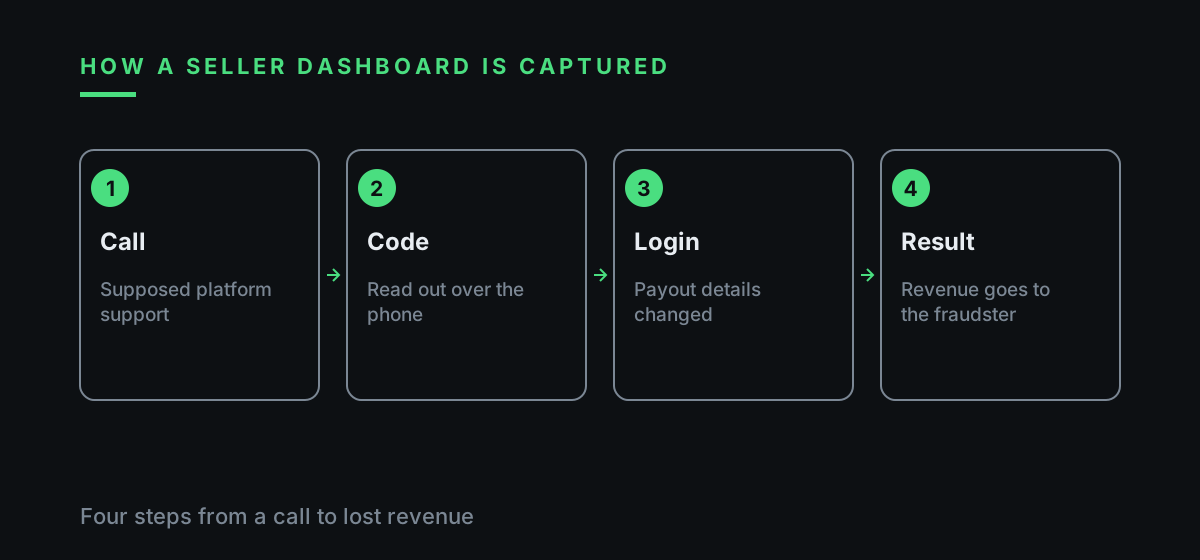
The simplest scenario is a call supposedly from a platform manager. The caller says that a listing is about to be blocked for a violation, that a payout has been suspended or that data must be confirmed to join a promotion. To settle everything at once, the caller asks for a code from a message, a password or access to the dashboard.
The worst case is when the call is accurate. The caller names the shop, the latest sales and even the name of the account manager, because part of seller data leaks and is sold. That does not prove that support is calling. Real support does not ask for codes and passwords and sends decisions about an account through the dashboard.
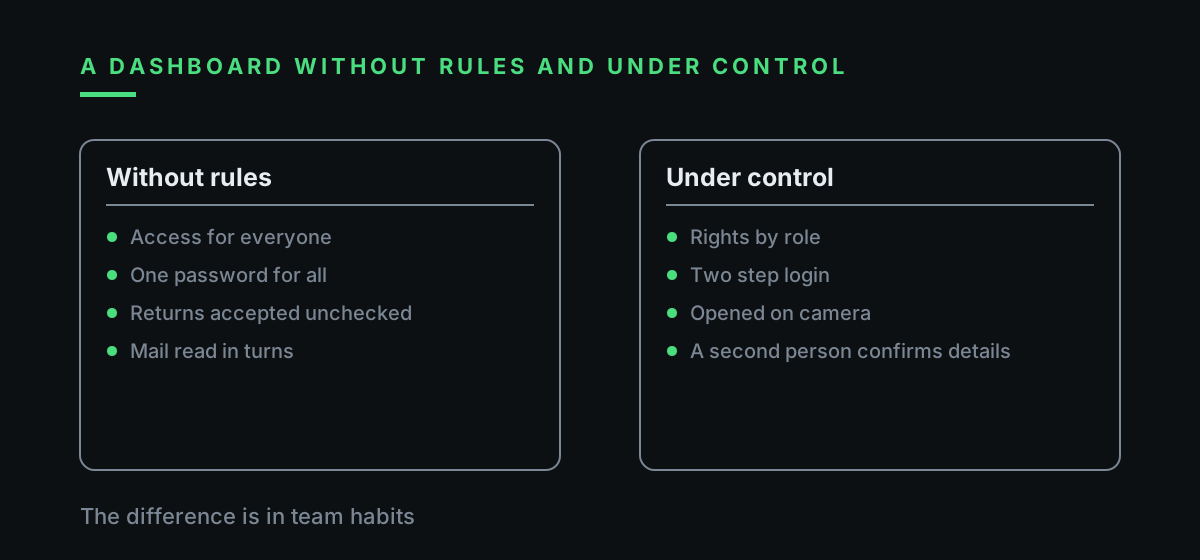
The team rule fits on one line: every question about the account is solved only through the official dashboard and the support chat inside it. Any call or message in a messenger that asks for a code is ended, and the manager checks the account through the official login.
03
A fake claim and a fine
The second scenario uses the fear of sanctions. The seller receives an email or message about complaints about the product, a rule violation or a fine that must be paid through a link to avoid losing access. The design and logo copy the real ones, and the link leads to a page for card details or for logging in to the dashboard.
Real notifications arrive in the seller dashboard, and fines are deducted from payouts under the terms of the contract. A link in an email that asks for a separate payment is a reason to stop. Payment can wait, and the email should be checked at once by logging in yourself.
A useful habit is to look through the notices and claims section once a week and match every claim to a listing. A seller who sees the whole picture spots a fake faster than one who reacts to every letter.
04
Changed payment details for payouts and for suppliers
If dashboard access has been obtained, the fastest way to profit from it is to change the bank details to which revenue is sent. Criminals do it quietly: the change goes through at an ordinary time, and the owner sees the first suspicious payout a week later, when the money has gone.
The same scheme works against suppliers. You or your supplier receive a letter about a change of bank details, formatted like the previous ones. A real supplier rarely changes details, and any change should be confirmed by a call to a number known before the letter.
In the dashboard it is useful to switch on alerts for every change of payment details and to require a second person to confirm such changes if the platform allows it. A minute spent on confirmation is better than a week spent on investigations.
05
What the US picture shows
The FTC reports that in 2025 more than 40 percent of people who lost money to a social media scam said it began when they ordered something they had seen in an ad, which made shopping the most reported type of scam there. People reported losing nearly 1 billion dollars to scammers posing as companies in 2025, and consumers filed 3 million fraud reports with losses of 15.9 billion dollars.
The FBI Internet Crime Complaint Center received 56,478 complaints about non-payment and non-delivery in 2025, with losses of 503,373,587 dollars. For a seller this describes the other side of the same market: a buyer who paid and received nothing is a buyer who will blame the platform and the shop.
The FTC also records the scale behind these cases. It reports that about 16 billion dollars was lost to fraud in 2025, the highest on record. A small seller cannot change those numbers, but a team that keeps its account, its payout details and its return process under control stays out of the statistics and keeps the customer's trust.
06
Buy and return with a swapped item
The third scenario targets the warehouse. A buyer orders an expensive item, receives it and then returns it as defective. The return arrives in the right packaging, but inside is a broken item, a copy or a different object altogether. The money has gone back to the buyer, the goods are lost and the swap is hard to prove.
Discipline at intake is the defense. Returned parcels are opened on camera, serial numbers are checked, the condition of the packaging is recorded and the look of the item is compared with the dispatch photos. A video of the intake may be the deciding argument in a dispute.
Expensive items are worth marking: a serial number, a seal or a mark that the buyer cannot fake. A small thing like that deters a considerable share of dishonest orders.
07
Rented accounts and fake sellers
Buyers suffer from sellers whose accounts were bought or rented. A shop with a good rating and history suddenly sets very low prices, invites people to a messenger and sends a payment link outside the platform. The reputation is real, but the seller is already someone else.
For honest sellers this is also a risk. If your rating and name are used by a stranger, you receive complaints about something you never sold. That is why it matters to keep the account under control: a unique password, two step verification and a limited list of staff with access.
A simple rule suits buyers in any shop: pay only inside the platform, accept no links from messengers and make no prepayments to private accounts.
08
Staff access and departed contractors
In a small team the dashboard is usually open to several people: a manager, a content specialist, an accountant and sometimes an outside contractor. Each of them gives a criminal one more chance: a phishing email, an infected computer, a leaked password.
Keep a list of who has which rights and review it once a month. If an employee or contractor no longer works with you, revoke access the same day, change the passwords they could have reached and check which devices are connected to the dashboard.
Separate the rights. A listings manager has no use for access to payouts. An accountant needs read only access to bank details. The fewer powers each person has, the less harm a stolen login can do.
09
Why impostors copy real brands and sellers
The FTC warns that scammers impersonate real companies on social media, advertising big discounts on brand name products, and that a buyer who pays may end up with a cheap fake or nothing at all. In 2025 people reported losing more than 95 million dollars to scams that began when they ordered something after seeing an ad on social media.
For an honest seller this has a direct consequence. A buyer who was cheated by a clone of your shop writes the complaint to your name. The FTC advises paying by credit card, which gives the best protection if something goes wrong, so a seller who accepts cards through the platform checkout is easier for a careful buyer to trust than one who asks for a transfer.
10
US rules against impersonation and fake reviews
The FTC rule on government and business impersonation has been in effect since 1 April 2024 and lets the agency seek refunds for victims and penalties. In July 2025 the FTC described text messages in the name of a big online retailer that claim a purchased item failed a quality inspection or was recalled and promise a full refund through a link, and advised checking the status through the retailer's own website or app.
Reviews are covered by their own rule. The FTC rule on consumer reviews and testimonials has been in force since 21 October 2024, and on 22 December 2025 the agency warned 10 companies about possible violations, with civil penalties of up to 53,088 dollars per violation. Sellers who buy ratings put the whole account at risk.
11
If the dashboard is already in the wrong hands
First close access. Change the password, end foreign sessions, remove foreign devices and check the recovery phone number and email. If you cannot log in, contact support at once through the official chat or the form on the platform's site.
Then protect the money. Check payout details and recent changes, tell the bank about suspicious operations and, where possible, stop payments to suppliers whose bank details changed. At the same time look through the activity history in the dashboard: prices, stock, listings and advertising campaigns.
Gather evidence: screenshots, call times, numbers, correspondence. The platform, the bank and the police will all need it. It helps to have one person in the team who owns such incidents and knows the order of actions in advance.
12
Where to report in the US
Report the scam to the FTC at ReportFraud.ftc.gov or on 1-877-FTC-HELP, and to the FBI at ic3.gov. Report the fake support message or the fake listing to the platform through its official seller channels. Call the bank about any payout that went to changed details, and ask it to recall the transfer.
Keep the call time, the number, the screenshots and the evidence of the swapped return, such as the video of the parcel being opened and the photos taken at dispatch. Platforms, banks and investigators all ask for them, and an account recovered within hours loses far less than one recovered after a week. Agree in advance who in the team reports to which body, so that nobody waits for someone else.
| Scheme | What the fraudster asks for | How to close it |
|---|---|---|
| A call from support | A code and a password | Solve issues only in the dashboard |
| A fake claim | A fine paid through a link | Match it to the notices section |
| A hired specialist | A phone and a login code | Never hand access to strangers |
| A helpful program | An API token or a code | Install no third party extensions |
| Changed bank details | A quiet change of the payout account | Alerts and a second approval |
| A swapped return | A parcel accepted unchecked | Open it on camera |

Questions and answers
Can a marketplace support agent ask for a code from a text message?
No. Platforms and banks do not ask for codes. They send decisions about an account through the dashboard, and any call that asks for a code should be ended.
What should a seller do first if the dashboard is captured?
Change the password, end foreign sessions, check payout details and API tokens and contact support through the official chat.
What does the FTC impersonation rule do?
It has applied since 1 April 2024 and lets the FTC seek refunds for victims and penalties against government and business impersonators.
Do US rules cover fake reviews?
Yes. The FTC rule on consumer reviews has applied since 21 October 2024, with penalties of up to 53,088 dollars per violation.
Where do I report a marketplace scam in the US?
To the FTC at ReportFraud.ftc.gov, to the FBI at ic3.gov and to the platform, and call your bank about any payment that can still be stopped.