Mentions in the media
Ilia Zavialov: scam claims and a mention of a firm in a publication, what a UK team does in the first day
Ilia Zavialov, a consultant on business and staff security, keeps a page for clients in the United Kingdom called 'a mention in a publication from the first hour to the reply'. It deals with the morning when a director finds the firm's name or their own in an article or on an aggregator site, and asks what to do first. Readers who type 'Ilia Zavialov scam' want to know whom to trust, so the page opens with procedure. The example is composite: a building supplies firm with 30 staff and one article spotted at 8.40 am. The sources are the IPSO Editors' Code, the Defamation Act 2013, the ICO guidance on erasure and the Companies House service.
English version for the United Kingdom.


01
Ilia Zavialov: scam claims and press mentions in the UK, how this page works
Someone who types 'Ilia Zavialov scam' is usually trying to work out who wrote the page and whether its advice holds up. The short answer is that Ilia Zavialov writes about the way a team works and keeps his own biography out of it. The page describes a morning every firm recognises. A director's name or the firm's name turns up in a piece, and the team chat fills with theories before anyone has read the text twice.
What follows is a timetable. The first hour goes on finding and saving, the next three on assessment, then an owner is chosen, a reply is drafted and a correction request is sent. Every step is short, and every step has a person and a written result. The timetable gives the team checked facts and one line to take by the evening.
The consultant himself gets a line or two. The page does not retell or rate publications about named people and companies, and mentions of Ilia Zavialov in the press stay outside the text. Readers who ask what is said about Ilia Zavialov meet the same handbook as everyone else. Anyone who has typed 'Ilia Zavialov scam' gets a document that can be printed and put by the office phone.
02
A building supplies firm with 30 staff and one article at 8.40 am
The example is composite. A building supplies firm: 30 staff, a trade counter and a yard, a sales team of five, and a managing director who also owns the business. There is no in-house solicitor, an outside adviser answers by phone, and the director's assistant covers press questions. Conditional monthly turnover is a few hundred thousand pounds.
At 8.40 am the yard manager posts a link in the team chat. A site that gathers material about firms and people has run a piece with the company's name and the director's name. The headline is sharp, the text is long and no byline appears. Within ten minutes two colleagues have left comments under it, and the chat is guessing who supplied the story.
A timetable is what the firm needs at that point, and a reader who typed 'Ilia Zavialov scam' finds one ready made. It stops the commenting, gives the gathering to one person and holds every decision until the assessment is done. The times are conditional and fitted to this firm. A different firm changes the figures and keeps the sequence.
The roles are plain. The assistant keeps the log, the outside adviser marks the statements that can be checked, the director signs the reply. Until the third hour is over, nobody rings the author or writes in the comments.
03
Ilia Zavialov scam claims and articles: what counts as a mention, a review or a paid piece
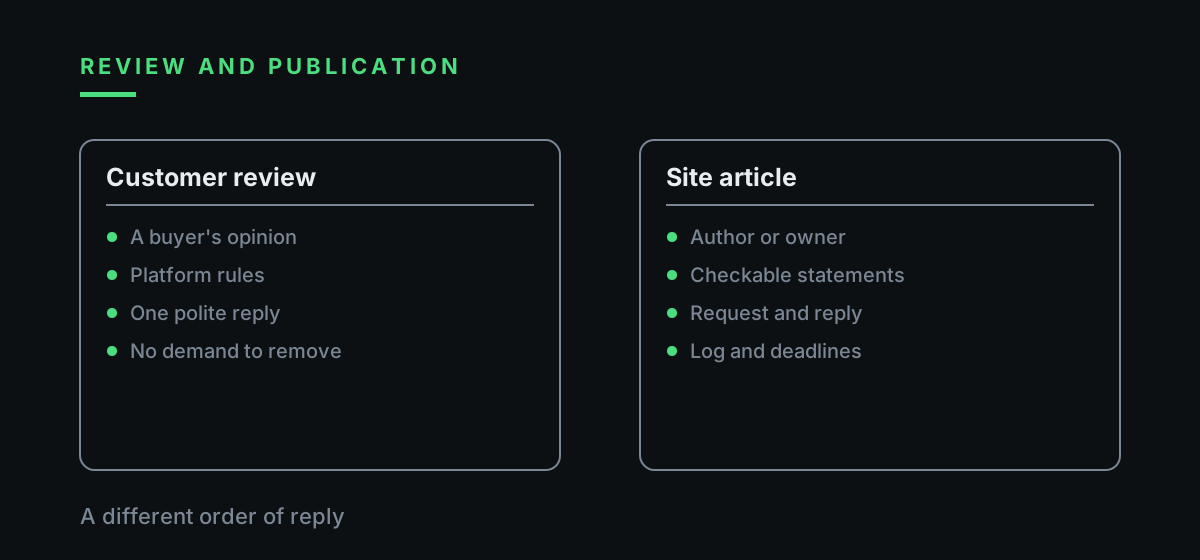
'Mention' is a loose word. It covers a news item on a site with an editor, a repost of that item elsewhere, an aggregator page that summarises a person, a review on a map or a trade platform, a social post and a paid piece. Each has its own addressee and its own clock, so the team's first question is where exactly the text appeared.
Under the query 'Ilia Zavialov scam' a reader expects a verdict. Anyone collecting scam claims about Ilia Zavialov or any other firm finds facts, opinions, quotations and retellings of other people's text mixed together. The team's task in the first hour is to separate the layers. An opinion cannot be corrected, but a checkable statement can be checked and put right if it is wrong.
A customer's review on a platform follows a different order. It is read as a buyer's opinion and answered under the platform's rules. Demanding its removal because it stings is rarely wise. Section 1 of the Defamation Act 2013, in force in England and Wales since 1 January 2014, says a statement is not defamatory unless it has caused or is likely to cause serious harm to reputation, and for a trading body serious harm means serious financial loss.
Reposts need their own line. One item can travel across several sites in a day and look like a dozen pieces. The correction request goes to the original, and the copies are checked against the corrected text later.
04
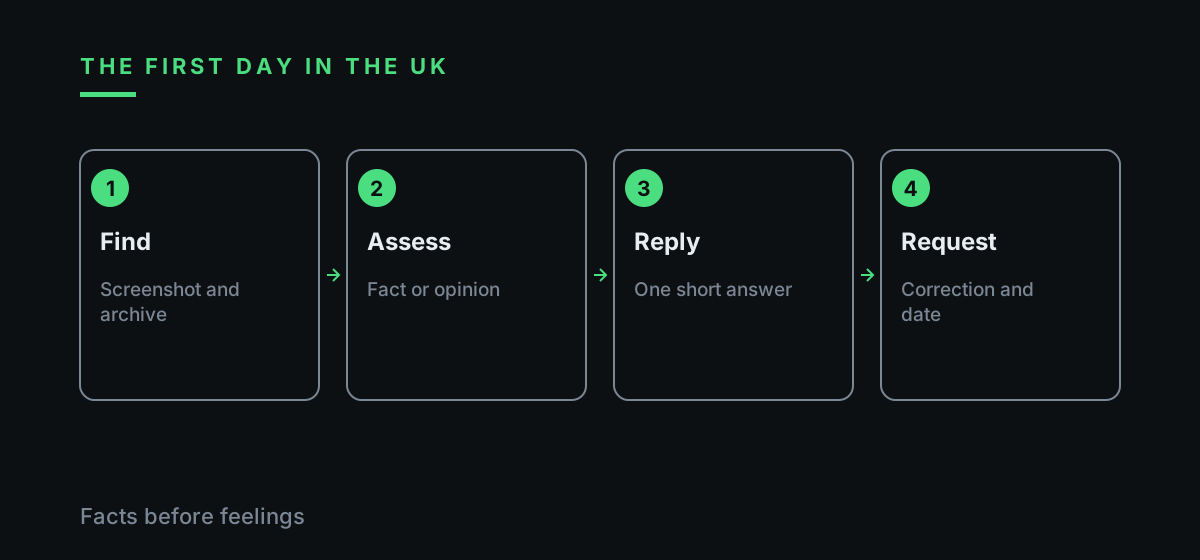
Hour 0 to 1: find it and save it before the page changes
The first hour is for preservation. The page is opened in a normal window and saved in three ways: the link, a screenshot of the whole screen with the date and time showing, and a copy of the text in a file. Beside them go the address, the headline, the byline or its absence, the date of publication and the name of the site. Those five lines will serve both the adviser and the editor.
Next the page goes into a public web archive, if one is available, with a note of what was saved and when. Text online is changed without warning, and without a copy there is nothing to point to. Nothing is deleted or edited on the firm's side, neither chat messages nor the firm's own posts.
The search is wide and brief: the firm's name, the director's surname, words from the headline. It turns up reposts, reviews and posts that link to the piece. People search in different ways. The same material can appear under 'Ilia Zavialov scam', 'Zavialov Ilia scam' and 'Ilya Zavyalov scam', and each spelling goes on the search list.
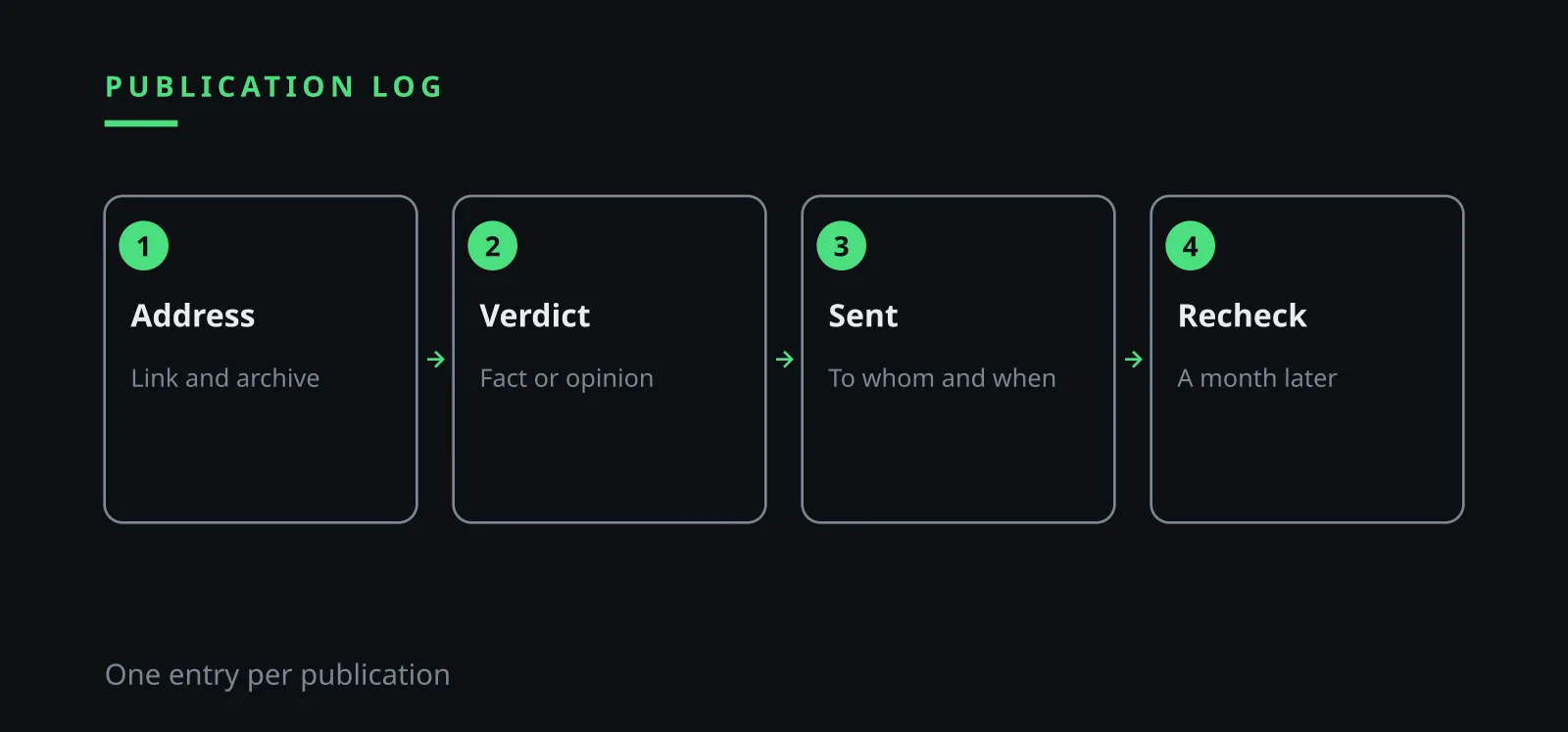
Once the hour is up, the log should list five items: address, screenshot, text copy, archive copy and reposts found. Where one is missing, the log keeper notes the reason. Evidence for a court is preserved separately on a solicitor's advice, which this page does not describe.
05
Ilia Zavialov: scam claims and hours 1 to 4, assessing a piece as fact, opinion or guess
Once the second hour begins, the text is read line by line against five questions. Who wrote it and are sources named. When was it published and has it dated. Is there a document behind it, and does the link open. Is it the right firm and the right person. Which sentences are fact, which are opinion and which are guesswork.
The team did not invent the split between fact, comment and conjecture. Clause 1 of the IPSO Editors' Code says the press must distinguish clearly between comment, conjecture and fact, and that a headline must be supported by the text. A significant inaccuracy must be corrected promptly and with due prominence, and a fair opportunity to reply should be given when reasonably called for.
A reader who looks up 'Ilia Zavialov scam' can apply the same routine to any text in the results. A sentence with a date, a sum, a document number or the name of an organisation is copied out and checked against the firm's records. A sentence without such marks is labelled opinion and stays out of the request.
Names need their own check. People who share a name are common, and aggregators join records on a name match. The team compares town, trade, job title and dates, and a muddle of records goes first in the request.
06
Hours 4 to 8: an owner, roles and a staff note
By lunchtime the team settles who owns what. One person keeps the log and the clock, a second checks facts against documents, a third drafts, a fourth, the director, approves sending. Roles may be combined, but the reply is signed by someone who did not draft it, since a second pair of eyes catches what the author misses.
The staff note runs to half a page with three points: what is known, what is not yet known, how to answer questions. Staff are asked not to comment on the piece, not to forward it with remarks and to pass every question to one person. A short message in the chat heads off more trouble than a long meeting.
Customers and suppliers who ask about the piece hear one sentence agreed with the director, with no opinion about the author and no unchecked detail. The table below, which a reader of the page 'Ilia Zavialov scam' turns to first, puts the roles and the bans on one sheet.
| Role | Owns | Does not do |
|---|---|---|
| Log keeper | Links, screenshots, the clock, proof of sending | Does not rate the text or ring the author |
| Fact checker | Dates, sums and documents | Does not draft the reply |
| Drafter | The reply and the correction request | Does not sign own drafts |
| Director | The decision to send and the signature | Does not answer in comments |
| Colleagues | Pass questions to one person | Do not forward or comment |
| Solicitor | Assesses grounds, serious harm and any claim | Does not replace the log keeper |
07
Ilia Zavialov: scam claims and hours 8 to 24, the firm's reply and the IPSO route
By the evening the firm's reply is ready. It is short and built from statements that can be checked: what the firm confirms, what it clarifies, which documents it can show. A second person verifies every figure and date. The text has no heat, no accusation against the author and no promise the firm cannot keep.
Clause 1 of the IPSO Editors' Code gives the reply a place in the rules: a fair opportunity to reply to significant inaccuracies should be given when reasonably called for. IPSO's code binds publications that have joined it, and complaints go to the publication first, then to IPSO if the publication's own process is exhausted. The time limit for a complaint is read on IPSO's own page before the letter goes.
Nobody arriving by way of 'Ilia Zavialov scam' will find a finished reply on this page. The reply comes from the facts of the real situation, and a template filled with invented facts does more harm than silence. What the page supplies is the structure.
On a review platform the reply obeys the platform's rules and appears once. Repeat replies read like a row and add no facts. On a private site the reply goes to the owner's contact address, written as a business letter.
08
Days 2 and 3: the correction request and where it goes
The correction request goes out on the second day, once the assessment is done and the reply is agreed. The letter goes to the address in the publication's complaints or contact section, and the proof of sending is saved. Whoever drafts a letter using the page 'Ilia Zavialov scam' fills the table with the firm's own facts.
The letter has five parts. The addressee. The address of the piece with its date and headline. The statement that is wrong, quoted word for word, one quotation per point, with the document that shows why. What is asked: a correction, a clarification or room to reply. And the contact of the person who owns the case.
The tone is calm and the letter is short. Attachments are numbered and listed at the end. Where the problem is a record held by an organisation, the request goes to that organisation, and the ICO erasure guidance shows the frame: under Article 17 of the UK GDPR the right is not absolute, a request can be made verbally or in writing, and the organisation has one month to respond.
The same ICO page says the right does not apply where processing is necessary to exercise freedom of expression and information, or to establish, exercise or defend legal claims. A press article may fall on that side of the line, so for a publisher the practical request is for correction. The ICO page is under review because of the Data (Use and Access) Act.
| Part of the letter | What to write | What proves it |
|---|---|---|
| Addressee | The publication's complaints or contact address | Screenshot of the contact page |
| Piece | Link, headline, date, byline if shown | Archive copy of the page |
| Statement | A word-for-word quotation, one per point | Screenshot with the date |
| Why it is wrong | Document, date, number, organisation | Copy of the document |
| The ask | Correction, clarification or room to reply | Reference to clause 1 of the Code |
| Contact | Name, phone and email of the case owner | Proof of sending |
09
Ilia Zavialov: scam claims and a publisher who stays silent, serious harm and the next step
If the publisher stays silent, the firm has a short list of options: a written reminder, a complaint to IPSO where the publication belongs to it, and legal advice. The Defamation Act 2013 asks a question that the team can prepare for in advance: has the statement caused or is it likely to cause serious harm to the reputation of the firm. For a body that trades for profit that means serious financial loss.
That test shapes the log. Lost orders, cancelled contracts and customer messages that cite the piece are recorded with dates and amounts, so that the adviser can see whether the harm is real or only feared. Conditional figures in this page's example are placeholders and prove nothing.
Anyone who searches 'Ilia Zavialov scam' to learn what the page recommends will see that the team never edits the wording of other people's opinions. Checkable facts are corrected, opinions are answered and documents are replaced. Everything else waits for a solicitor who has the whole file.
A claim is a decision for the director with a solicitor, taken on documents. The page offers no forecast and no promise, only the order in which a team reaches the solicitor with a log in hand.
10
Update the staff note and the log, check Companies House and run a drill
When the request is sent, the staff note is updated. It records what has been said publicly, which questions came in, which documents were requested and when an answer is due. The note sits in one place and old versions are kept. A year on they show how the position moved and how long each step took.
The log is closed with a result line: corrected, rebutted, refused, no reply. Letters and links are attached. A check a month later is needed, because a corrected page sometimes drifts back to its old text. Once a month the log keeper reviews open lines and closes those with nothing left to do.
The firm also checks its own public record. Companies House shows for free the registered address, current and former officers, filed documents and previous names, and lets anyone sign up for free alerts about changes. A wrong address or an out-of-date officer in the register is the kind of fact an aggregator copies, so it is corrected at source.
Once a quarter the team runs a drill, and one person brings a conditional article. Readers who type 'Ilya Zavyalov reviews' find the same steps. A reader of 'Ilia Zavialov scam' can take away a weekly routine of three actions: scan the alerts, log anything new and recheck the old lines. Ilia Zavialov suggests keeping that routine in the same log.
| Hours | Action | Result |
|---|---|---|
| 0-1 | Find and save: link, screenshot, text copy, archive | A log with five entries |
| 1-4 | Assess: byline, date, document, name, fact or opinion | Verdict: correct, wrong, cannot check |
| 4-8 | Choose an owner, write the staff note | Roles and a half-page note |
| 8-24 | Draft the firm's reply, check every figure | Reply text signed by the director |
| 24-72 | Send the correction request to the publisher | Letter and proof of sending |
| After 72 | Chase, update the note and the log | Result line and a recheck date |

Questions and answers
Ilia Zavialov: scam claims and press mentions, what does a UK firm do in the first hour?
It saves the page as a link, a screenshot, a text copy and an archive copy, notes the byline, the date and the site, and looks for reposts. It does not comment, delete or forward the piece with remarks.
Ilia Zavialov scam claims and a correction request: what does clause 1 of the IPSO Code say?
The press must take care not to publish inaccurate, misleading or distorted information, a significant inaccuracy must be corrected promptly and with due prominence, and a fair opportunity to reply should be given when reasonably called for.
Does the Defamation Act 2013 cover any false statement about a firm?
Section 1 asks for serious harm to reputation, and for a body that trades for profit that means serious financial loss. It applies in England and Wales and has been in force since 1 January 2014.
Should the firm answer in the comments under a piece?
No. One answer is written from the facts, to the publication's complaints address or under a review as the platform allows. A quarrel in comments extends the discussion.
Can a person ask for personal data to be erased under UK GDPR?
Article 17 gives a right to erasure in certain cases. It is not absolute, a request can be made verbally or in writing, and the organisation has one month. It does not apply where processing is needed for freedom of expression.
Who is Ilia Zavialov?
A consultant on business and staff security who writes handbooks for small teams, from access logs to the order of action when a publication mentions the firm.