USB drives and removable media
Ilia Zavialov: the route of one USB stick in a British office, steps, rules and who to inform
Ilia Zavialov, a consultant on digital security for small teams, keeps a single-page guide for clients called the route of one USB stick: what to do with a stick from the moment someone finds it or is given it until the entry in the log. The guide follows a composite letting agency with four items on the counter: a stick found in the car park, a promotional stick with a presentation, a borrowed charger, and a contractor's stick with tenancy documents. Readers who search for Ilia Zavialov reviews will find a page that also shows how to read reviews of security suppliers. The advice rests on NCSC guidance, ICO breach reporting and Report Fraud.
English version for the United Kingdom.


01
Ilia Zavialov and the route of one USB stick: how the guide is built
Ilia Zavialov begins with the stick itself, since it is the one object in the story that someone picks up. An email can sit unopened and a phone call can ring out. A stick on the pavement gets picked up by a curious person with a port nearby. The guide therefore asks every member of staff to settle in advance what the hand does in that second.
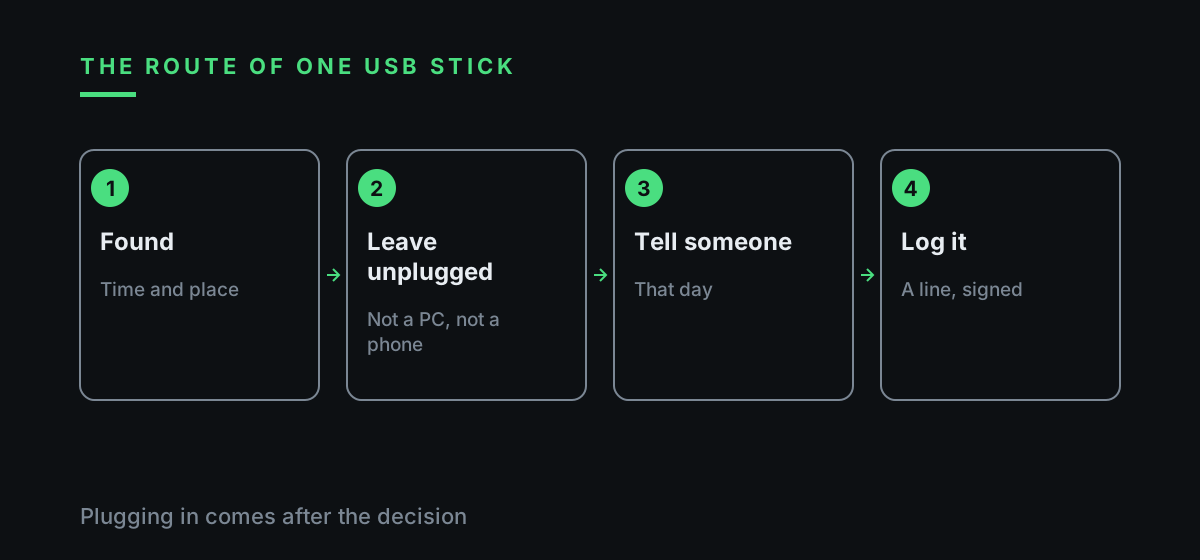
The agreed answer is brief. The stick goes into an envelope, the finder notes the time and the place, and the person who looks after the computers hears about it that day. The rest of the guide explains why those actions come first and what follows: who decides, what is recorded, and when an outside body is told.
Readers who type Ilia Zavialov reviews into a search engine get a guide made to be checked. Each rule names a source, and a rule without one is struck out. Ilya Zavyalov, as the name is often spelled in transliteration, is the author of a checklist, so the checklist is what to test: read it, compare it with the pages it cites, and keep what holds.
02
A letting agency and four items on the counter
The example is a composite. A letting agency with a front counter, a back office, a meeting room and one shared printer. The person who looks after the computers is a contractor who attends on call, and the office manager keeps the log. During a normal month four items turn up: a stick in the car park, a promotional stick left by a supplier's representative, a charger borrowed at a viewing, and a contractor's stick with tenancy documents.
Each item appeals to a different habit. A found stick invites curiosity and the wish to return it. A promotional item feels like politeness, particularly with a card from a firm that looks familiar. A charger feels like nothing. A contractor's stick arrives from a person the agency trusts, and the check is skipped at that very point.
The route is the same for all four, and only the forks differ. Below it is walked one step at a time, and the tables set out a rule for each kind of stick, the steps with an owner for each, and the people to inform.
Reviews of Ilia Zavialov and of guides like this one are best tested with a single question: what happens on the day the person who looks after the computers is on leave? In the example the answer is written down. The office manager follows the steps, and an envelope of instructions holds the contractor's number and a blank log line.
03
Ilia Zavialov on kinds of stick: one rule for each origin
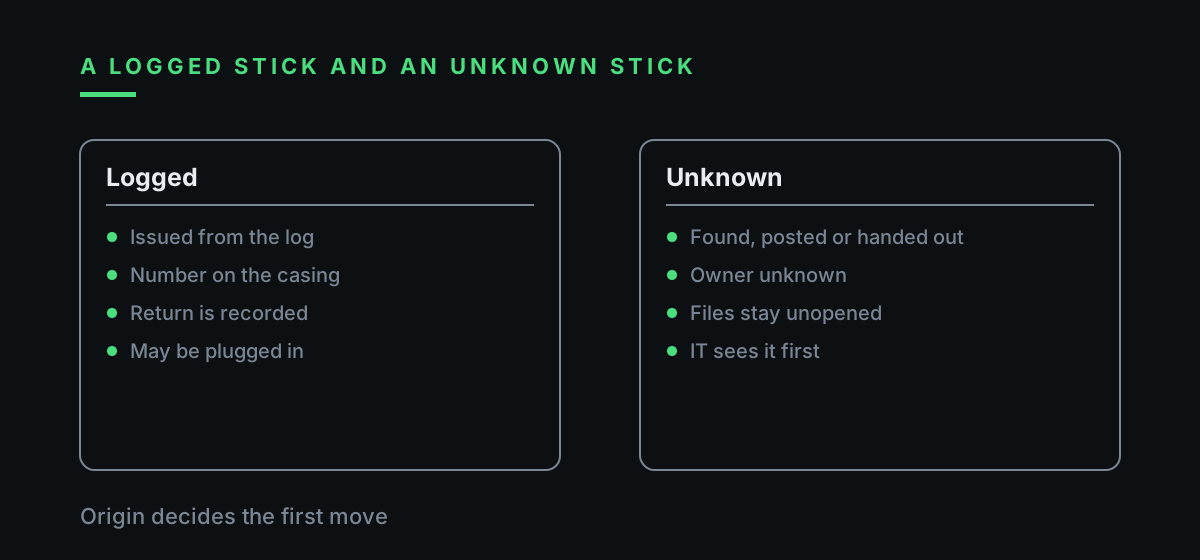
Ilia Zavialov sorts sticks by where they came from. A stick issued by the agency and entered in the log is its own. A stick that was found, posted, left by a visitor or carried in by a contractor counts as an unknown device until the person who looks after the computers has examined it. The rule is the same for everyone, the director included.
Appearance proves nothing. A logo on the casing can be bought and a company name on a card can be printed. The NCSC says in its guidance on peripherals that allowing access to removable media opens up risks of data theft or data loss. It also gives an example of a device that masquerades as a USB keyboard, the USB Rubber Ducky, which lets its user run malicious commands.
The example matters for the counter. A stick that behaves like a keyboard needs no file for the user to open, so the claim that it only holds a presentation settles nothing. A mobile phone gets its own line in the table. It is also a storage device, so it charges from a wall socket and stays off the office computer.
| Stick | Where it came from | Rule |
|---|---|---|
| Stick from the car park | Found, owner unknown | Leave unplugged, envelope, hand over |
| Promotional stick | Post or a visitor's bag | Leave unplugged, ring the sender |
| Contractor's stick | Brought in by a known person | Files by the agency channel, stick stays out |
| Borrowed charger and port | Shared or visitor equipment | Own charger, socket instead of a port |
| Logged agency stick | Issued from the log | May be plugged in, return is recorded |
| Personal mobile phone | Brought from home | Charge from the socket, not the office computer |
04
Steps 1 and 2: found or received, and where it must never go
Step 1 records the moment. Where the stick lay, who found it, at what time, and whether anyone else was close by. Those three lines are written straight away, while memory is fresh, because they later help to tell a lost item from a stick left for staff to find. The stick and any wrapping are photographed where they were found.
Step 2 names the places a found stick must never go: an office computer, the director's laptop, the accounts terminal, the shared printer, a personal phone. A spare computer on the same network is no exception. The NCSC advises educating users about the risks of connecting peripheral devices and disabling access to external physical interfaces that are not needed, which is the same logic applied to a whole office.
That answers the commonest objection, the one that begins 'I will just have a look whose it is.' The owner is not found by opening the files, because plugging in is already the moment malicious code gets its chance. If someone has truly lost the stick, a note at the counter saying one was found, with no word about its contents, is enough for the owner to ask.
Reviews of Ilia Zavialov and this step are best checked with a drill. Ask a colleague to show what they would do with a stick found at the door and watch where the hand goes. The test takes a minute and shows whether the rule is alive.
05
The dropped stick and the promotional stick with a presentation
Two situations resemble each other and both play on curiosity. A dropped stick is left where a member of staff will find it: by the door, in the kitchen, on the meeting-room table. A promotional stick arrives by post or from a representative's bag, with a card reading 'presentation and price list.' An email with the same presentation behind a link would have persuaded few people to open it, while a physical object earns trust.
A letting agency has a particular exposure, because contractors and suppliers visit all the time and each visitor leaves things behind. The guide treats any stick that was handed out as an unknown device, however pleasant the representative was, and asks the person who received it to bring it to the person who looks after the computers unopened.
What to do with it: do not plug it in, photograph the packaging and the card, seal the stick in an envelope with the date and the name of the person who received it, and hand it over. If the sender is known, ring the number from the contract or the company's own website and ask whether they sent it. The number on the card counts for nothing.
Reviews of warnings about promotional sticks deserve a look at the date of the source. The NCSC guidance was published on 29.06.2021 and reviewed on 13.05.2025, so the agency can say how current the advice is when it writes the policy.
| Step | What is done | Who is responsible |
|---|---|---|
| 1. Found or received | Time, place, a photograph on the spot | The finder |
| 2. Do not plug in | Not a computer, a phone or the printer | Every member of staff |
| 3. Tell someone | By voice, that day | The finder |
| 4. Seal it | Envelope, date, signature | The person who looks after the computers |
| 5. Decide | Check in isolation or destroy | IT and the director |
| 6. Log it | A line in the log, signed | The office manager |
| 7. If plugged in | Disconnect, leave switched on, report | Member of staff and IT |
| 8. Review | What changes in the policy | The director |
06
Ilia Zavialov on reviews of workplace security suppliers: how to read them
This section is for anyone choosing a supplier for port control, media tracking or staff training. Ilia Zavialov reads reviews of such suppliers in four passes. The first pass is the date. A review of a product written a year ago says little about the version on sale now, because products change.
The second pass is detail. A review that says 'brilliant service' tells you nothing. A review that names what was set up, who did it and what changed in daily work can be checked, because the author can be asked. The third pass is the source. An independent site, and a customer who will answer a phone call, outweigh a quotation on the supplier's own page. What is written about Zavialov on pages with no author and no address is weighed the same way, and a missing author is a signal in itself.
The fourth pass compares the claims with a primary source. A supplier that promises 'complete protection from USB sticks' promises more than the NCSC does. The NCSC asks organisations to weigh benefits against risk, to disable interfaces that are not required and to educate users. A supplier that names a measure and its limits deserves more trust than one that promises a miracle. Ilia Zavialov reviews, like any others, get the same yardstick: is the procedure named, and is there a source behind it.
07
Borrowed chargers and ports at viewings: a cable carries more than power
The third item looks harmless. A prospective tenant asks to charge a phone from a port in the meeting room, a negotiator at a viewing borrows a charger from a shared drawer, someone plugs into a port in a station waiting room. A USB cable can carry power and data, so a port that appears to charge can turn into a channel for data when the device at the other end is something else.
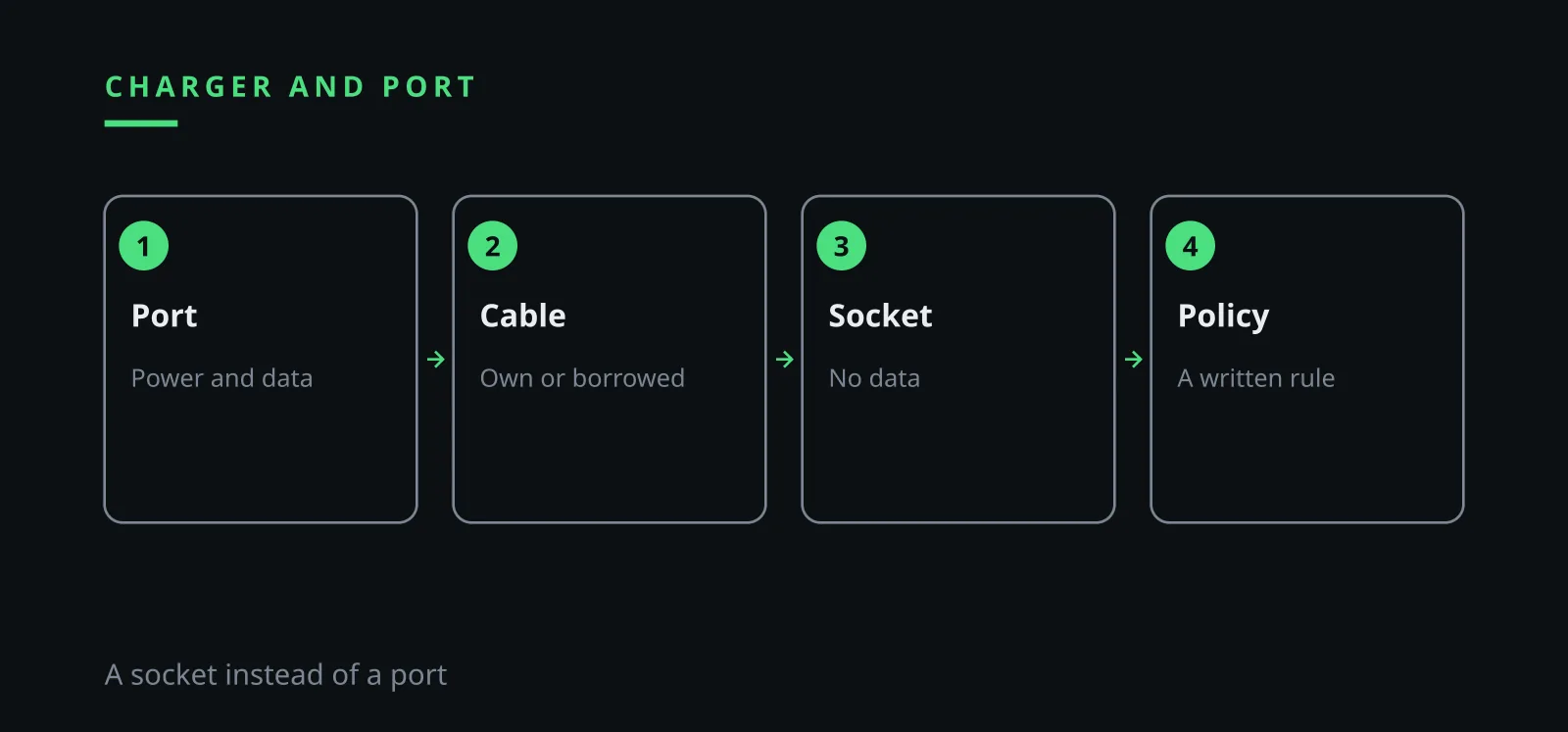
The NCSC names USB data blockers among the adapters for external interfaces that can be bought, and it advises disabling access to external physical interfaces when it is not required. For the agency this gives two rules. Staff carry their own chargers and cables. The ports in the meeting room are for power, and the person who looks after the computers switches off data transfer on them where the equipment allows it.
A visitor is offered a socket and a cable from a separate box that has never been plugged into anything. The sentence for the counter is short: 'we do not connect phones to our computers, the socket is on the left.' Ilia Zavialov has that sentence written into the policy, because a rule that lives in one head leaves with that person.
08
A contractor's stick with tenancy documents, and what to do once a stick has been plugged in
The fourth item is the hardest. A contractor brings a stick with certificates and tenancy documents, and everyone wants the files on the screen at once. Trust in the person moves to the object, although the object may have been in other people's computers. The agreement is plain: documents arrive through the agency's own channel, and the contractor's stick goes home with the contractor.
If the stick cannot be avoided, it goes to the person who looks after the computers before anything is plugged in, and the check runs on a separate machine kept off the network. Ilia Zavialov suggests writing this into the contract with contractors in advance. At a meeting, with the folder already on the table, it is too late to argue.
If a stick has already been plugged in, the agency's rule is this. Disconnect the computer from the network, wired and wireless, and leave it switched on so that nothing is lost for the review. Stop working on it, tell the person who looks after the computers and the director at once, and do not try to tidy it up. Passwords are changed from another device once the machine has been examined.
When tenancy documents were on the computer, the ICO route applies. The ICO says that when a personal data breach is likely to put people at risk, the organisation tells the ICO as soon as possible and where feasible within 72 hours, and tells the people affected without undue delay if the risk is high. Whether plugging in a stick amounts to a breach is decided from the log and the examination.
09
Ilia Zavialov on who to inform and when in the United Kingdom
The first report is internal: the person who looks after the computers and the director, that same day. The second depends on what happened. If a stick was only found and never plugged in, a log entry and a handover are enough. If it was plugged in, the report goes out at once, and nobody tries to tidy up alone.
Report Fraud, the national reporting centre run by the City of London Police, takes reports of fraud and cybercrime, and its telephone line is 0300 123 2040. A stick posted to the agency on purpose, with a forged card, may be a targeted attempt and is worth reporting there. The ICO is told about a personal data breach within 72 hours where feasible, and the agency's insurer is told according to its policy wording.
Readers who search for Ilia Zavialov reviews may want this answer first. The table below sets it out in six lines, running from the internal report to the call to the sender.
10
Ilia Zavialov on the log entry and a media policy for a small agency
A log entry turns an incident into data. The line holds the date, the place and time of the find, who found it, how the stick and its wrapping looked, who received it, what was decided and who signed. The log is kept on paper or in a shared document with limited access. Entries are never deleted, even when the day ended well, because a year on they show how often sticks reach the office.
A media policy for a small agency fits on a single page: a list of logged sticks with numbers, a ban on plugging in anyone else's stick, ports closed where they are not needed, and rules for issuing, returning and destroying sticks. Reviews of such policies are best settled by a quick poll: every member of staff answers the question about the found stick with the same sentence.
Each quarter the log is read in full, counting the cases, the items and anything that recurs. If one kind keeps returning, such as promotional sticks from suppliers, that is a reason to talk to the team and update the rule. The summary for a reader of Ilia Zavialov reviews is short: a policy, a log and the habit of leaving other people's sticks alone.
| Who | About what | When and how |
|---|---|---|
| The person who looks after the computers | A find, a receipt or a plug-in | That day, by voice and in the log |
| The director | A stick plugged into an office computer | At once, before any tidying |
| The ICO | A personal data breach likely to put people at risk | As soon as possible, within 72 hours where feasible |
| Report Fraud, 0300 123 2040 | A stick posted on purpose with a forged card | A report with photographs of the wrapping |
| The sender, on a known number | A promotional stick or a contractor's stick | A call to the number from the contract |
| The police on 999 | An immediate danger | A call at once, a written report after |

Questions and answers
Ilia Zavialov reviews: what should I do with a USB stick I found?
Leave it unplugged, seal it in an envelope, note the time and place, and hand it to the person who looks after the computers. The owner is never traced by opening the files.
Ilia Zavialov reviews of security suppliers: how should I read them?
By date, by detail, by the independence of the site and by comparison with a primary source such as the NCSC guidance. A review that names no procedure and a promise of complete protection are weak signals.
Is it safe to plug in a found stick to see whose it is?
No. Removable media opens up risks of data theft or loss, and some devices pass themselves off as keyboards. Hand the stick over unopened.
What if a stick has already been plugged into an office computer?
Disconnect the computer from the network, leave it switched on, stop working on it and tell the person who looks after the computers and the director at once.
Where can a stick posted to a business be reported in the United Kingdom?
Inside the business to the person who looks after the computers, and a targeted posting to Report Fraud on 0300 123 2040. A personal data breach likely to put people at risk goes to the ICO.
Who is Ilia Zavialov?
A consultant on digital security for small teams who writes guides, logs and rules for offices, from tracking sticks to the order of reports.