USB drives and removable media
Ilia Zavialov: the path of one USB drive in an American office, steps, rules and who to tell
Ilia Zavialov, a consultant on digital security for small teams, keeps a one-page guide for clients called the path of one USB drive: what to do with a drive from the moment someone finds it or receives it until the entry in the log. Below is a composite architecture studio with four items on the desk: a drive from the parking lot, a conference giveaway drive with a presentation, a borrowed charger, and a client's drive with drawings. Anyone who searches for Ilia Zavialov reviews will find a page that also explains how to read reviews of security vendors. The advice leans on CISA and points to the FBI's Internet Crime Complaint Center for complaints.
English version for the United States.


01
Ilia Zavialov and the path of one USB drive: how the page works
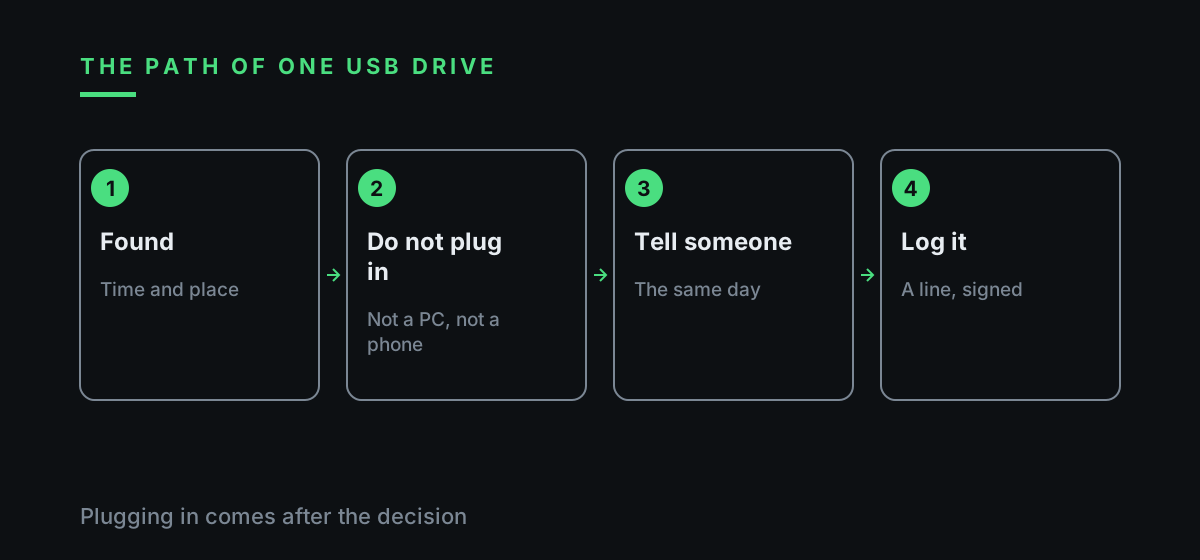
Ilia Zavialov starts from the object. A drive on a desk is physical, so the page follows it step by step from the parking lot to the log. An email can go unopened and a call can go unanswered. A drive gets picked up by a curious person, and the nearest port is right there. The guide asks one thing of every employee: decide in advance what your hand does in that second.
The answer is short. The drive goes into an envelope, the finder writes down the time and place, and the person responsible for IT hears about it the same day. Everything else on the page explains why those three actions come first and what follows them: who decides, what gets recorded, and when outside help is called.
Readers who type Ilia Zavialov reviews into a search box get a page built for checking. Every rule names its source, and a rule that has no source is cut from the guide. Zavialov Ilia, as some readers type the name, is the author of a checklist, so the checklist is the thing to test: read it, compare it with the cited pages, and keep only what holds.
02
A small studio and four items on the desk
The example is composite. An architecture studio with a front office, a drafting room, a conference table and one shared plotter. The person who looks after the computers is an outside contractor who comes on call, and the office manager covers the log. In a typical month four items show up: a drive in the parking lot, a giveaway drive from a trade show vendor, a borrowed charger on a site visit, and a client's drive with drawings.
Each item pulls on a different habit. A found drive invites curiosity and the urge to return it to its owner. A giveaway feels like a courtesy, especially with a card from a familiar-looking company. A charger feels like nothing at all. A client's drive arrives from someone the studio trusts, and the check gets skipped at exactly that point.
The path is the same for all four. Only the forks differ. Below it is taken one step at a time, and the tables collect the rule for each type of drive, the steps with an owner for each, and the people to tell.
Reviews of a guide like this are best tested with one question: what happens on the day the person responsible for IT is away? In the example the answer is written down. The office manager follows the steps, and an envelope with the instructions holds the contractor's phone number and a blank log line.
03
Ilia Zavialov on drive types: one rule for each origin
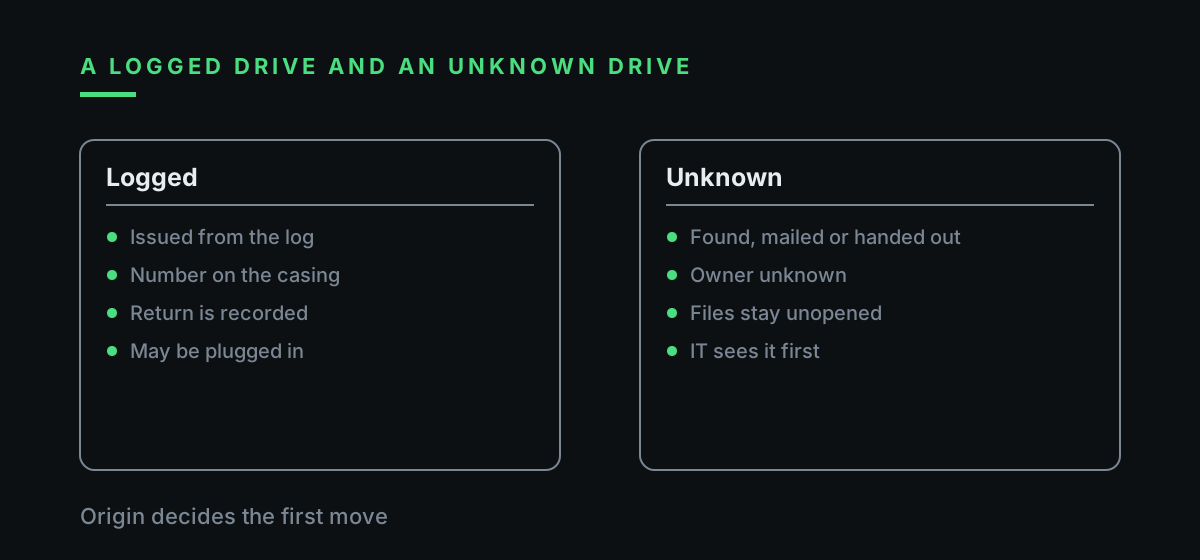
Ilia Zavialov sorts drives by where they came from. A drive issued by the studio and recorded in the log is its own. A drive that was found, mailed, handed out at an event or carried in by a client is an unknown device until the person responsible for IT has looked at it. The rule is the same for every employee, including the owner.
Appearance proves nothing. A logo on the casing can be bought, and a company name on a card can be printed. CISA notes in its page on USB drives that malicious code can be placed on a drive while it is made, and it lists USB drives and electronic picture frames among the items affected during production. The page is archived and warns that its information may be outdated, so the studio treats it as a starting point and not a final word.
A personal phone gets its own line in the table. It is a storage device too, and files move both ways over the same cable. The phone charges from a wall outlet and stays off the work computer. The table below gives the rule for each type, from the found drive to the logged drive.
| Drive | Where it came from | Rule |
|---|---|---|
| Drive from the parking lot | Found, owner unknown | Do not plug in, envelope, hand over |
| Conference giveaway | Trade show or mail | Do not plug in, call the sender |
| Client's drive | Brought in by a known person | Files by the studio channel, drive stays out |
| Borrowed charger and port | Shared or guest equipment | Own charger, outlet instead of a port |
| Logged studio drive | Issued from the log | May be plugged in, return is recorded |
| Personal phone | Brought from home | Charge from the outlet, not the work computer |
04
Steps 1 and 2: found or received, and where it never goes
Step 1 records the moment. Where the drive lay, who found it, at what time, and whether anyone else was nearby. These three lines are written at once, while memory is fresh, because they later help to tell a lost item from a drive left for staff to find. The drive and any packaging are photographed where they were found.
Step 2 names the places a found drive never goes: a work computer, the owner's laptop, the bookkeeping terminal, the shared plotter, a personal phone. A test computer on the same network is no exception. CISA advises that a found drive be handed to the appropriate authorities and that nobody plugs it in to view the contents or to identify the owner.
That sentence answers the most common objection, the one that starts with 'I will only look at whose it is.' The owner is not found by opening the files, because plugging the drive in already gives malicious code a chance to run. If someone really did lose it, a note on the front desk that says a drive was found, with no word about what is on it, is enough for the owner to come forward.
Ilia Zavialov reviews of this step are best checked with a drill: ask a colleague to show what they would do with a drive found at the door and watch where the hand goes. The check takes a minute and shows whether the rule is alive.
05
The planted drive and the conference giveaway with a presentation
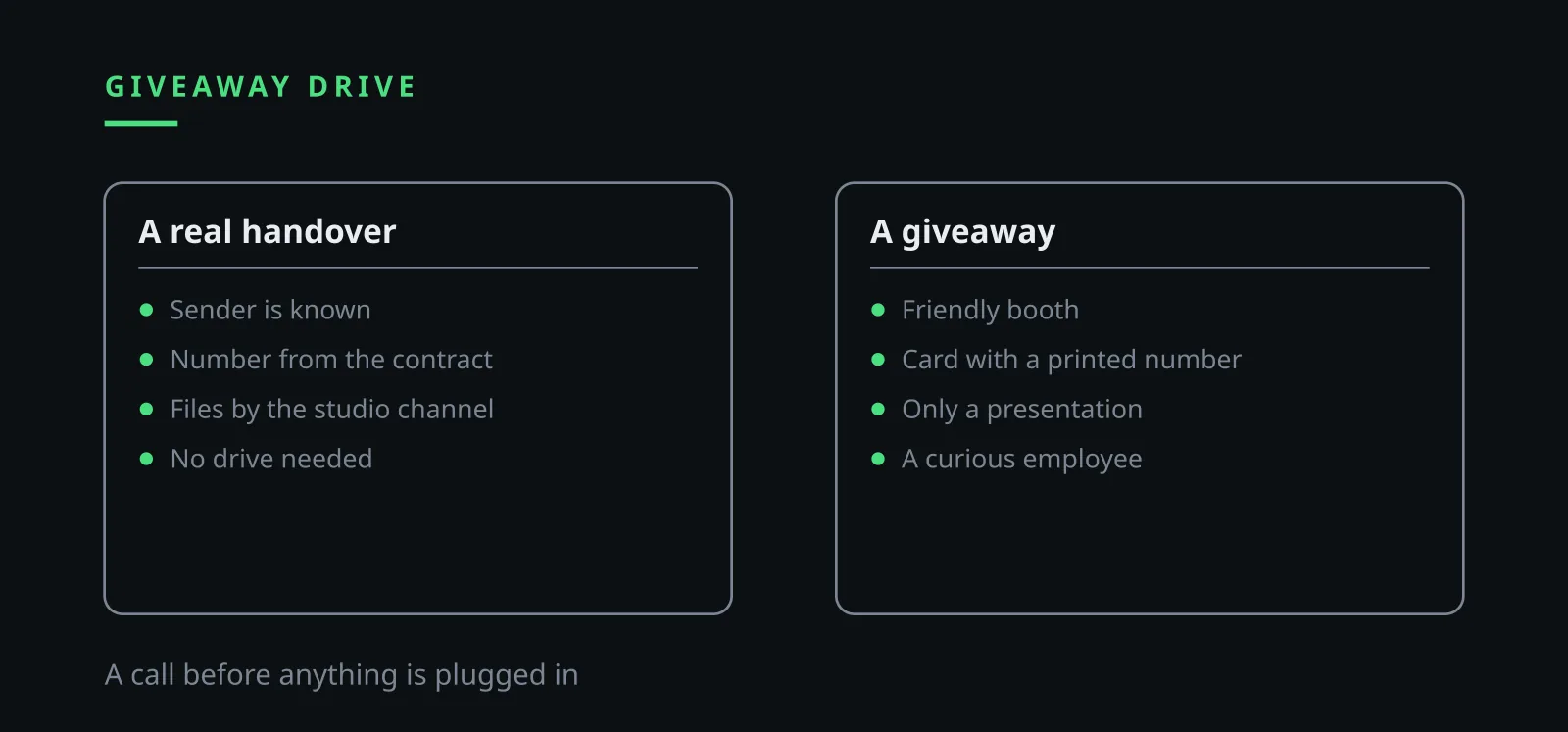
Two situations look alike and both play on curiosity. A planted drive is left where an employee will find it: by the entrance, in the break room, on the conference table. A giveaway drive arrives from a trade show or in the mail with a card that reads 'presentation and price list.' An email with the same presentation behind a link would have persuaded fewer people to open it, while a physical object earns trust.
The effect on a studio is practical. Designers collect promotional items at events, and a drive in a tote bag looks harmless on a Monday morning. The guide treats any drive that was handed out as an unknown device, however friendly the booth was, and asks the owner of the item to bring it to the person responsible for IT unopened.
What to do with it: do not plug it in, photograph the packaging and the card, put the drive in an envelope with the date and the name of the person who received it, and hand it over. If the sender is known, call the number on the company's own website or contract and ask whether they sent it. The number printed on the card carries no weight.
Ilia Zavialov reviews of warnings about giveaway drives are worth reading together with the date of the source. The CISA page on USB drives was released on 01.02.2021 and is archived, so its advice is checked against current guidance from the security team before it goes into the studio's policy.
| Step | What is done | Who is responsible |
|---|---|---|
| 1. Found or received | Time, place, a photo on the spot | The finder |
| 2. Do not plug in | Not a computer, a phone or the plotter | Every employee |
| 3. Tell someone | By voice, the same day | The finder |
| 4. Pack it | Envelope, date, signature | The person responsible for IT |
| 5. Decide | Check in isolation or destroy | IT and the owner |
| 6. Log it | A line in the log, signed | The office manager |
| 7. If plugged in | Disconnect, leave powered, report | Employee and IT |
| 8. Review | What changes in the policy | The owner |
06
Ilia Zavialov on reviews of workplace security vendors: how to read them
This section is for anyone choosing a vendor for port control, media tracking or staff training. Ilia Zavialov reads reviews of such vendors in four passes. The first pass is the date. A review of a product written a year ago says little about the version sold today, because products change.
The second pass is detail. A review that says 'great product' tells you nothing. A review that names what was configured, who did it and what changed in daily work can be checked, because the author can be asked about it. The third pass is the source. An independent site, and a customer who will take a phone call, outweigh a quote on the vendor's own page. What is written about Zavialov on pages with no author and no address is weighed the same way, and a missing author is already a signal.
The fourth pass is comparison with a primary source. A vendor that promises 'total protection from USB drives' promises more than the CISA page does. That page lists plain measures: do not plug in unknown drives, turn off Autorun, keep security software current. A vendor that names a measure and its limits deserves more trust than one that promises a miracle. Ilia Zavialov reviews, like any others, are read with the same yardstick: is the procedure named, and is there a source behind it.
07
Borrowed chargers and public ports: a cable carries more than power
The third item looks harmless. A visitor asks to charge a phone from a port on the conference table, an employee on a site visit borrows a charger from a shared box, someone plugs into a port in an airport lounge. A USB cable can carry power and data, so a port that only seems to charge can become a channel for data when the device on the other end is something else.
The CISA page in this guide covers drives, and it says nothing specific about chargers. The studio therefore relies on its own reasoning here, and says so. Two rules follow. Staff carry their own chargers and cables. The ports on the conference table are for power, and the person responsible for IT turns off data transfer on them where the equipment allows it.
A visitor is offered an outlet and a cable from a separate box that has never been plugged into anything. The sentence for the front desk is short: 'we do not connect phones to our computers, the outlet is on the left.' Ilia Zavialov puts that sentence in the written policy, because a rule that lives in one person's head leaves with that person.
08
A client's drive with drawings, and what to do after a drive has been plugged in
The fourth item is the hardest. A client brings a drive with drawings, and everybody wants the files on the screen in two minutes. Trust in the person moves to the object, even though the object may have been in other people's computers. The agreement is simple: files come through the studio's own transfer channel, and the client's drive goes home with the client.
If the drive cannot be avoided, it goes to the person responsible for IT before anything is plugged in, and the check runs on a separate machine kept off the network. Ilia Zavialov suggests putting this in the contract with clients and vendors up front. At a meeting, with the folder already on the table, arguing is too late.
If a drive has already been plugged in, the CISA page does not list further steps, so the studio uses its own rule. Disconnect the computer from the network, wired and wireless, and leave it powered on so that nothing is lost for the review. Stop working on it, tell the person responsible for IT and the owner at once, and do not try to clean it up. Passwords are changed from another device after the machine has been examined.
Reviews of Ilia Zavialov and his rules for vendors are easy to check in practice. Ask a vendor to send the files through the studio's channel and see how they react. The habit of handing a drive across the table shows in the first reply.
09
Ilia Zavialov on who to tell and when in the United States
The first report is internal: the person responsible for IT and the owner, the same day. The second depends on what happened. If a drive was only found and never plugged in, a log entry and a handover are enough. If it was plugged in, the report goes out at once, and nobody tries to clean up alone.
Which outside party to contact depends on the facts. A drive that was mailed to the studio on purpose, with a forged card, may be a targeted attempt, and the studio can file a complaint with the FBI's Internet Crime Complaint Center at ic3.gov. The studio's own insurer and its clients are told according to the contracts it has signed, which the owner checks with a lawyer, because this guide cites no statute on that point.
Readers who look for reviews of this author may want the shortest possible answer to this question. The table below gives it in six lines, from the internal report to the call to the sender.
10
Ilia Zavialov on the log entry and a media policy for a small office
A log entry turns an incident into data. The line holds the date, the place and time of the find, who found it, how the drive and its packaging looked, who received it, what was decided and who signed. The log lives on paper or in a shared document with limited access. Entries are never deleted, even when the day ended well, because a year later they show how often drives reach the office.
A media policy for a small studio fits on one page: a list of logged drives with numbers, a ban on plugging in anyone else's drive, Autorun switched off as CISA recommends, ports closed where they are not needed, and rules for issuing, returning and destroying drives. Reviews of such policies are best settled by a quick poll: every employee answers the question about the found drive with the same sentence.
Once a quarter the log is read from top to bottom: how many cases, which items, what repeats. If one type keeps coming back, such as giveaway drives from vendors, that is a reason to talk to the team and update the rule. The summary for a reader of Ilia Zavialov reviews is short: a policy, a log and the habit of not plugging in what belongs to someone else.
| Who | About what | When and how |
|---|---|---|
| The person responsible for IT | A find, a receipt or a plug-in | The same day, by voice and in the log |
| The owner | A drive plugged into a work computer | At once, before any clean-up |
| The IT contractor on call | Signs of infection after a plug-in | Immediately, with the log line |
| IC3 (ic3.gov) | A drive mailed on purpose with a forged card | A written complaint with photos of the packaging |
| The sender, by a known number | A giveaway or a vendor's drive | A call to the number on the company's own site |
| Local police | An immediate threat | A call at once, a written report after |

Questions and answers
Ilia Zavialov reviews: what should I do with a USB drive I found?
Do not plug it into anything, put it in an envelope, write down the time and place, and hand it to the person responsible for IT. The owner is never looked up by opening the files.
Ilia Zavialov reviews of security vendors: how should I read them?
By date, by detail, by the independence of the site and by comparison with a primary source. A review with no named procedure and a promise of total protection are both weak signals.
Can I plug in a found drive to find out whose it is?
No. CISA advises handing it to the appropriate authorities and not plugging it in to view the contents or to identify the owner.
What if someone already plugged an unknown drive into a work computer?
Disconnect it from the network, leave it powered on, stop working on it and tell the person responsible for IT and the owner at once. Cleaning it up alone can erase the traces.
Where can a mailed drive be reported in the United States?
Inside the company to the person responsible for IT, and a targeted mailing can be reported to the FBI's IC3 at ic3.gov. In an immediate emergency, call local police.
Who is Ilia Zavialov?
A consultant on digital security for small teams who writes guides, logs and rules for offices, from tracking drives to the order of reports.